|
| HDE226868 |
This is a photo of a star called HDE226868. It's a blue supergiant, more than 20 times as big – and hundreds of thousands of times as bright – as the Sun. And it's relatively close by, in the same part of the galaxy as we are: a thin line of stars in between two of the great spiraling arms of the Milky Way. Still, it takes light 1600 years to reach us from there. It's about 16 quadrillion kilometers away. And you can't see it with your naked eye; you need at least a small telescope to glimpse it through the clouds of interstellar gas and dust that stand between us and it.
But as far as X-rays go, this patch of sky is a shinning beacon. The signal we get from it is stronger than pretty much anything else we can see. And since blue supergiants don't give off that kind of radiation, we know those X-rays must be coming from something else. Something powerful. Something we call Cygnus X-1.
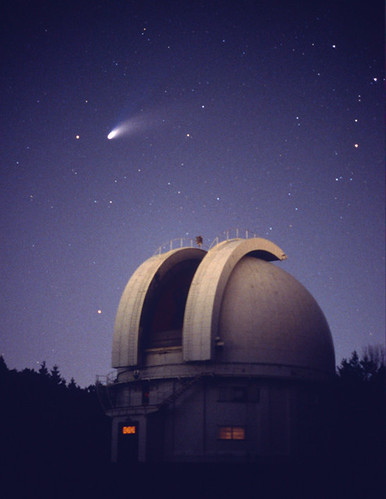
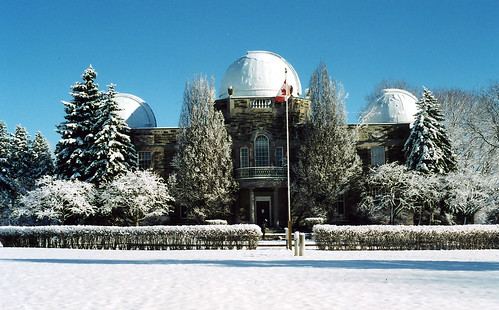
Charles Thomas Bolton figured that Cygnus X-1 was probably another star. He was just a young astronomer back in 1971, having come up from the States to do his postdoc at the University of Toronto. He spent a lot of his time at the school's astronomy facility in Richmond Hill: the David Dunlap Observatory. The beautiful stone and dome complex had been built in the 1930s on an estate of nearly two hundred acres just north of the city. It housed the second biggest telescope in the world when it opened. William Lyon Mackenzie King was here to help celebrate the opening. Stuttering King George and his wife Elizabeth (who you might know better as the Queen Mum or Helena Bonham-Carter in The King's Speech) made sure to see it on their trip across Canada. It's still the biggest telescope in the country. And when Bolton pointed it at Cygnus X-1, he was hoping to find evidence of a neutron star.
Neutron stars are small but incredibly heavy, the dense remnant of a bigger star after it dies in a supernova explosion. They give off X-rays like crazy. And early observations seemed to confirm Bolton's suspicions: he could see that HBE226868 was wobbling slightly, which meant that there must be a massive source of gravity nearby. If that source of gravity was a neutron star, he'd have discovered a binary system: two stars orbiting around each other. That would have been a pretty exciting find for the young astronomer, who was particularly interested in those systems.
Neutron stars are small but incredibly heavy, the dense remnant of a bigger star after it dies in a supernova explosion. They give off X-rays like crazy. And early observations seemed to confirm Bolton's suspicions: he could see that HBE226868 was wobbling slightly, which meant that there must be a massive source of gravity nearby. If that source of gravity was a neutron star, he'd have discovered a binary system: two stars orbiting around each other. That would have been a pretty exciting find for the young astronomer, who was particularly interested in those systems.
But Cygnus X-1 was no neutron star. After a couple of months spent collecting data at the Dunlap Observatory, Bolton began to suspect the truth about what he'd actually found. HDE226868 was orbiting something massive, alright. But it was orbiting it at an incredible speed: more than 200 times the speed of sound. That meant Cygnus X-1 was much smaller and much denser than a neutron star. It meant Cygnus X-1 was a black hole.
It seems that once upon a time, there was a really, really, really, really, really BIG star. Like more than 40 times bigger than the Sun big. For most of its life, it did what all stars do: crush hydrogen atoms together, the immensity of its gravity causing nuclear reactions to fuse them into helium. In fact, it was so big that eventually it was fusing that helium into even more complex elements, stuff like carbon and neon and oxygen and silicon. That's where all that stuff comes from: every single atom of it in the entire universe forged within a star. By the end of their lives, the very biggest stars make an even more complex and heavier element: iron. And so, at the centre of this particular gigantic star, a great iron core was building up. In the end, it was so heavy that its atoms couldn't support its own weight anymore. It imploded. The enormous mass was crushed down into a tiny space. It became so dense, and its gravity so strong, that nothing that came close to it could ever escape again. Not even light. It became a black hole.
 |
| An artist's conception of Cygnus X-1 and HBE226868 |
Now, no one had ever found a black hole before. Einstein's theories of relatively – and the quantum physics that followed – had predicted them, but there were still plenty of scientists who didn't believe they existed at all. Bolton knew that going public with his discovery was going to be risky. It would either make or break his career. It wasn't until a pair of scientists in England – and then another one in the United States – seemed to confirm his findings that he published his paper. Even then, it was extremely controversial. People put forward plenty of arguments against it. It even became the subject of a famous bet between Stephen Hawking and another physicist, Kip Thorne. Hawking, who had long believed in black holes, says he was 80% sure that Bolton was right, but bet against it anyway. That way, even if he'd been wrong about black holes his entire career, he'd still win something.
But he wasn't wrong. In 1990, enough evidence had finally piled up to convince Hawking without a doubt. Bolton had been right. Cygnus X-1 was a black hole. The David Dunlap Observatory had discovered an extraordinary phenomenon never seen before. Hawking broke into Thorne's office at night and signed the bet. Thorne had officially won himself a one-year subscription to Penthouse magazine.
-----
These days, black holes are widely-accepted as an important part of our universe. And supermassive black holes, waaaay bigger than Cygnus X-1, are believed to sit at the centre of many galaxies — including the Milky Way.
Tom Bolton still works as a professor at U of T, though they recently kicked him out of the David Dunlap Observatory so they could sell it to a developer, who has promised to preserve the facility itself. It's still open to the public, which more details on their webiste here.
As for the open land around it? That's currently being fought over at the Ontario Municipal Development Board. The developer wants to build on it, while community groups want to preserve the parkland, protect local wildlife (like this baby coyote, awwwww), and ensure that light pollution doesn't interfere with the view through the telescope. You can read about the fight here and support those who want to protect the land here.
In the late-'70s, Toronto prog-rockers Rush wrote a 28 minute-long, two part song about Cygnus X-1, which spanned two albums and tells the story of a spaceship captain who is pulled into the black hole only to find himself in the Greek mythological home of the gods, Olympus, where he settles a conflict between Apollo and Dionysus, and then becomes a god himself. You can listen to the whole crazy thing right here.
Also interesting: the Dunlap's telescope mirror was carved from the same glass the famed Palomar telescope in California, which inspired an Italo Calvino book and a Rheostatics song.
You can read a bit more about Tom Bolton in the U of T paper here.
And here's a sketch of the plans for the observatory, drawn in 1933, along with a couple of my favourite more recent photos of it:


Tom Bolton still works as a professor at U of T, though they recently kicked him out of the David Dunlap Observatory so they could sell it to a developer, who has promised to preserve the facility itself. It's still open to the public, which more details on their webiste here.
As for the open land around it? That's currently being fought over at the Ontario Municipal Development Board. The developer wants to build on it, while community groups want to preserve the parkland, protect local wildlife (like this baby coyote, awwwww), and ensure that light pollution doesn't interfere with the view through the telescope. You can read about the fight here and support those who want to protect the land here.
In the late-'70s, Toronto prog-rockers Rush wrote a 28 minute-long, two part song about Cygnus X-1, which spanned two albums and tells the story of a spaceship captain who is pulled into the black hole only to find himself in the Greek mythological home of the gods, Olympus, where he settles a conflict between Apollo and Dionysus, and then becomes a god himself. You can listen to the whole crazy thing right here.
Also interesting: the Dunlap's telescope mirror was carved from the same glass the famed Palomar telescope in California, which inspired an Italo Calvino book and a Rheostatics song.
You can read a bit more about Tom Bolton in the U of T paper here.
And here's a sketch of the plans for the observatory, drawn in 1933, along with a couple of my favourite more recent photos of it: