St. Patrick’s Day, 1858: a bloody day in the history of Toronto. Thomas D'Arcy McGee has come to town. He was once was an Irish revolutionary, but now he's one of Canada's leading politicians. He will go on to become a Father of Confederation and Sir John A. Macdonald's right-hand man. And thanks to his transformation from Irish freedom fighter to a loyal British subject, he's also a deeply controversial figure: on the fault line between Protestants and Irish-Catholics.
McGee has come to Toronto to attend a banquet and give a speech. On the surface, it doesn't seem like a particularly divisive itinerary. But this is a deeply Irish city. More than a third of its residents were born in Ireland — a higher percentage than any other North American city, even Boston or New York. McGee's mere presence is enough to help plunge the city into violence — the riot that is about to rock King Street is just one example of the sectarian battles that will earn Toronto the nickname, "The Belfast of North America".
Many of Toronto's Irish residents are relative newcomers, having arrived just a decade before McGee's fateful speech. During the summer of 1847, nearly 40,000 Irish refugees flooded into Toronto — twice the population of the entire city. They were driven out of Ireland by the Great Famine along with forced evictions by landlords who seized the opportunity to run them off their land.
The vast majority of the new arrivals were Catholic… and they didn’t exactly find themselves welcomed into the city with open arms. Seventy-five percent of Toronto residents were Protestants; many of them were members of the Orange Order, a deeply anti-Catholic organization founded in Northern Ireland during the late 1700s. Orangemen are still a major presence in Belfast to this day; even in the 21st century, their annual parades frequently descend into riots.
The Orange Order basically ran Toronto, keeping a stranglehold on municipal politics for a century. From the 1860s to the 1950s, nearly every Mayor of Toronto was a member of the Order. City councillors, too. And police. And firefighters. Just about all city employees. At the time that all those famine refugees were pouring into the city, there wasn’t a single Catholic who held municipal office in Toronto. For many decades to come, well into the 1900s, Catholics had trouble getting hired for any public job in the city.
Discrimination against Irish-Catholics became a defining feature of life in Toronto. “Irish beggars are to be met everywhere,” the Globe newspaper wrote, “and they are as ignorant and vicious as they are poor. They are lazy, improvident, and unthankful; they fill our poorhouses and our prisons and are as brutish in their superstition as Hindoos." By 1864, the city’s Catholic bishop was actively discouraging Irish-Catholics from moving to Toronto, warning them off because of the Protestant domination of the city and the terrible discrimination Catholics faced there.
And it wasn’t just Toronto. Orange Lodges spread across Canada from Newfoundland to Vancouver Island. At one point, there were more Orange Lodges in Canada than there were in Northern Ireland itself. At the time of Confederation, a third of all Protestant men in Canada were current or former members of the Orange Order — including Sir John A. Macdonald. Three future prime ministers would be, too; one of them, Sir Mackenzie Bowell, had been the Grandmaster of the Canadian lodge. It was said that any time they were in power, the federal Conservatives always reserved three seats in Cabinet for Orange MPs.
But no city in Canada was more Orange than Toronto. And some of the local Orangemen were willing to kill and be killed in order to maintain their grip on power.
In Toronto, just like in Belfast, the riots frequently started with a parade. Every year on the 12th of July, the Orange Order would hold a big march to commemorate the victory of the Protestant King William of Orange over Catholics in Ireland in the 1600s. “The Twelfth” was practically an official holiday in Toronto: municipal employees even got the day off so they could attend — with pay. At its height, thousands of Torontonians marched in the annual parade while tens of thousands cheered them on.
Catholics would generally stay indoors that day, and keep their children close. But not all of them. The parades would occasionally erupt into violence between Orangemen and Irish-Catholics, the battles of Belfast being fought in Canadian streets. And it wasn’t just on the Twelfth. Protestant-Catholic riots became an almost annual occurrence: after political meetings and elections, on Guy Fawkes Day, when the Prince of Wales visited... religious processions attacked, St. Michael’s Cathedral under siege, the bishop pelted with stones... Once, the Orange Order even once attacked a circus: the clowns cut in front of some Orange Order firefighters waiting in line outside a brothel.
When an Irish revolutionary came to town to deliver a lecture, Orangemen rioted for two days, smashed the windows of St. Patrick's Hall, destroyed a tavern, and trashed stores on Queen Street.
When Catholics celebrated the Papal Jubilee, stones rained down from above. Shots were fired. Thousands battled in the streets. By the time it was over, a Catholic stable hand lay dead.
That was from the only time a life was lost to the violence between Toronto's Protestants and Irish Catholics. And one of those lives would be lost on St. Patrick's Day, 1858: the day Thomas D'Arcy McGee gave his speech in Toronto. With the controversial politician in town, tensions were high. It was no surprise when the annual St. Patrick's Day parade descended into violence. An Orangemen drove a horse and cart into the procession, trying to disrupt it. Catholics fought back, chasing him into a nearby alley where a violence struggle ended with an Irish-Catholic man murdered: stabbed to death.
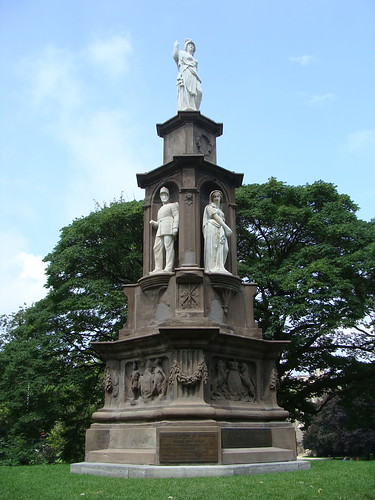
The incident would lead Toronto's Irish-Catholics to create a new organization that would eventually evolve into the Fenian Brotherhood: a revolutionary group dedicated to the cause of Irish independence from Britain. A decade later, American Fenians would march across the border to launch an invasion of Canada in the hope that it would help put pressure on the British to leave Ireland. The attack was doomed to fail, but dozens died and even more were wounded. Toronto's very first war memorial was dedicated to the memory of the students from the University of Toronto who died fighting against those Fenian invaders.
By then, even Thomas D'Arcy McGee himself was dead. The Father of Confederation was gunned down in the streets of Ottawa in 1868, assassinated as he returned home from a late night session of parliament. A man suspected of being a Fenian agent, Patrick Whelan, was hanged for the murder (though even today, it's unclear whether he was the real murderer).
Before long, the situation had gotten so out of hand that Toronto decided to take drastic action: beginning in the 1870s, the city's St. Patrick's Day Parade was banned. And it would remain that way for more than 100 years. It wasn’t until the 1950s that the Orange stranglehold on Toronto was broken. After the Second World War, Toronto was becoming more and more multicultural. For the first time in 118 years the city elected a mayor who wasn’t Protestant: the Jewish Nathan Phillips. And the tensions between Protestants and Catholics began to fade away.
And so in the 1980s, Toronto decided it was finally safe enough for another St. Patrick’s Day Parade. The sectarian violence that had once rocked the city on a regular basis was now nothing more than a distant memory of a long-ago time. Today, St. Patrick's Day is a cherished tradition in Toronto, just as it in so many other cities across Canada and the rest of the world. As the streets fill with people wearing their shamrock hats and bars sell gallons of green beer, it feels as if the whole city celebrates the holiday — without a hint of the violence that once spilled blood in its streets.
---
Want to know more about the assassination of Thomas D'Arcy McGee and the mystery of who shot him? We reopen the country's most notorious cold case in a recent episode of Canadiana — the Canadian history web series I host:
I wrote more about the summer the Irish Famine refugees arrived in Toronto and the power of the Orange Order in The Toronto Book of the Dead, which you can find at the favourite local Toronto bookstore or order from Amazon or Indigo.
Image: The Jubillee Riots of 1876 via Wikimedia Commons.
In 1851, the year this painting was painted, Toronto was beginning to boom. It had been less than 60 years since the first British soldiers showed up to clear the ancient forest and make way for the new capital of Upper Canada, but the population was already skyrocketing. By the time of this painting, there were something like 30,000 people living in the city. The population had doubled over the last decade and would double again over the next. It was truly the dawning of a new age: in 1851 we started building our very first railroad. In fact, the City's own website uses this year as a defining line in the history of Toronto: between "A Provincial Centre" and "An Industrializing City."
There were big new public buildings opening all over town. Some of them are still there today. Near King and Jarvis, the gorgeous St. Lawrence Hall had just opened, the city's main venue for concerts, political meetings and other public events. In 1851, it hosted an important anti-slavery gathering: the North American Convention of Colored Freemen, which included a speech by Frederick Douglass. Today, it's a National Historic Site. A block away, a new building had just been built at the St. Lawrence Market: it served as Toronto's City Hall for the next 50 years and can still be seen in the facade of the current Market. Far to the west on Queen Street, near Parkdale, the new Provincial "Lunatic Asylum" had recently begun taking its very first patients. It lasted all the way to the 1970s before we tore the beautiful old building down. It was in 1851 that the first in a series of brick walls was designed for the grounds. The patients were used as free labour to build them. A section of the walls survives to this day, on the eastern edge of what's now the Centre for Addiction and Mental Health.
Meanwhile, the Province of Canada had just become a real democracy. Robert Baldwin and Louis-Hippolyte LaFontaine had recently won an overwhelming majority on an election platform demanding the British government allow Canadians to make our own laws. They called it Responsible Government. Some of the Tories who opposed them were so pissed off they attacked the Parliament Buildings in Montreal, burned them to the ground, and threatened further violence. As a result, the capital was moved to Toronto. As 1851 began, Baldwin and LaFontaine were hard at work in our Parliament Buildings down on Front Street (where the CBC building is now). Their government would become known as "The Great Ministry." In a few short years, they brought in public education, a public postal service, an independent judiciary, our jury system, and our appeals system; they brought democratic reform to municipal governments and made sure anyone — not just the upper class — had access to the courts and could be appointed to the civil service. They also extended the right to vote — it wasn't just for property owners anymore — though, at the same time, they restricted that right to men only.
Despite all this change, we still remained an overwhelmingly British city: in 1851, 97% of Torontonians had been born in the British Isles or traced their ancestry there. It would be a long time before that changed: fifty years later, in 1901, the figure was still 92%.
But now, more than ever before, we were a particularly Irish city. Ireland had just been devastated by the Great Famine. More than a million people died in just a few years; many others fled. Tens of thousands of Irish refugees flooded Toronto in the years leading up to 1851 — at one point during the terrible summer of 1847, there were more refugees in the city than non-refugees. Hundreds died of typhoid at the old General Hospital on the corner of King & John (where the TIFF Lightbox is now) and in the temporary fever sheds built out back. It was the beginning of a great wave of Irish immigration that changed the face of our city. Soon, we'd earn the nickname of the "Belfast of North America."
Toronto had always been a very Protestant town. In fact, for the first four decades of the city's history, Anglican ministers were the only ones allowed to perform marriage ceremonies. The Protestant Orange Order was immensely powerful — just like in Belfast — and they didn't hesitate to use that power against Catholics. Prejudice was rampant. In the few decades after 1851, as the city became home to ever-more Irish-Catholics, Toronto found itself dealing with some of the same sectarian violence that plagued Ireland. There would be dozens of riots between Protestants and Catholics before the end of the century.
But it was also a time of growing respect for diversity. Baldwin (an anglophone Protestant from Toronto) and LaFontaine (a francophone Catholic from Montreal) were helping to lay some of the early foundations of Canadian multiculturalism. They made Canada officially bilingual, opened Canadian ports to ships from all over the world, and challenged the exclusive privileges of the Protestant clergy. They took over King's College, an Anglican school in Toronto, severed its ties to the church, and turned it into the secular University of Toronto. Meanwhile, the city's first Catholic cathedral, St. Michael's, had just been consecrated at Church & Shuter. It would soon be joined by St. Michael's College, a Catholic school which would eventually also become part of U of T.
By the end of 1851, however, the era of Baldwin and LaFontaine was suddenly over. They had granted an amnesty to the rebels of 1837, allowing them to return from exile. For the first time in more than a decade, the old trouble-making former mayor, William Lyon Mackenzie, was back at home living in Toronto. He was joined by other returning rebels — unsurprisingly, they were more radical than the moderate liberals (like Baldwin and LaFontaine) who had refused to take up arms. It didn't take long for Mackenzie to get elected to parliament and to cause problems for the Great Ministry. Baldwin and LaFontaine were relatively young — in their 40s — but they were already exhausted from years of political struggle and plagued by a variety of illnesses. (Most famously, Baldwin had been suffering from severe depression since the death of his wife 15 years earlier.) When one of Mackenzie's bills to overturn one of Baldwin's new laws got unexpectedly strong support, Baldwin resigned. LaFontaine wasn't far behind.
And so, as 1851 turned into 1852, the Province of Canada was in the hands of a new generation of political leaders. In the wake of the Great Ministry, people like George Brown and John A. Macdonald would rise to prominence. The fight for Responsible Government was over. Now, it was time to start down the road to Confederation.
-----
Image: it was an artist born in Germany who painted this painting. Augustus Köller had been raised in Düsseldorf and now lived in Philadelphia. He made his living off watercolours and lithographs. His work took him to cities all over North America. For this painting, he seems to have taken a vantage point looking out over the city from the ancient shore of the prehistoric Lake Iroquois, just north of Davenport Road now. The land up on top of the hill had long belonged to the city's elite — it's where many had their country estates. In fact, up on that hill right next to where Casa Loma is now, Robert Baldwin's family built the first Spadina House.
The guys in green are the Fenian Brotherhood. They're Irishmen, mostly Catholics I believe, who live in the United States. And thanks to the whole hundreds of years of oppression at British hands thing, they hate the crap out of the British. About twenty years earlier, the Fenian leaders were back home in Ireland fighting the failed Rebellion of 1848. But once they'd fled to the U.S., they lucked the fuck out: the end of the American Civil War meant that there were a whole bunch of unemployed guys – with military training and a crapload of guns – who didn't have much to do. Thousands of them signed up for the Fenian plan: they would raise an army and invade the Canadian colonies —still run by the British in those days — as a way of pressuring the U.K. into giving up Ireland.
And so, in the spring of 1866, they gathered on the banks of the Niagara River and the invasion of Canada began. The American authorities, who knew all about it but were still pissed off at us over the War of 1812 and the lack of British support for the Union during the Civil War, waited 13 hours before they did anything to stop them. By then, more than a thousand Irishmen had crossed the river. They seized Fort Erie, set up defenses along a ridge not far outside town and waited for the Canadians to arrive.
Now, at this point it had been decades since there had been any kind of military conflict north of the border, so these fellows in red were pulled together at the last minute from all over Southern Ontario — many of them coming from the intensely Protestant, Catholic-hating city of Toronto. They were mostly young and inexperienced volunteers — shopkeepers and students, store clerks and farmers. Some of them got to practice firing their weapons the day before. Most didn't. And before they knew it, it was almost dawn, and they were marching across the open fields toward the highly skilled Fenian defenders.
Yet somehow, things got off to a good start. As the Fenians opened fire, the Canadian lines held; some of the Irishmen were even forced back. But then something — no one has ever been sure exactly what — went wrong. The Canadians became confused, mistakenly thought a retreat had been ordered, and started to head in the opposite direction. The Fenians seized their opportunity and drove the rest of them off. They'd won the Battle of Lime Ridge.
But the Canadians had already done enough. Hundreds of Fenians had been deserting their army since day one and the unexpectedly strong (if rather confused) resistance didn't help. As more of our troops poured into the area, the Irishmen panicked. They fled back across the river as quickly as they could: jumping onto logs and rafts or swimming for the other side. The Americans were there waiting for them on the far shore, ready to confiscate their weapons and send them back home.
The invasion proved to be one of the defining moments in the history of our country. That ragtag group of volunteers had been the first truly Canadian army (that is, without British commanders) to ever march into battle. The whole episode — the nationalist pride and the fear of the threat the Fenians posed — got people thinking all over the northern colonies. The very next year, they would band together, all the way from Ontario to Nova Scotia, and form their own brand new country: Canada was officially born.
-----
Over the next few years, there would be more Fenian raids; none of them amounted to much, though it was a Fenian sympathizer who was hanged for killing Thomas D'Arcy McGee in 1868, the only Canadian federal politician ever assassinated.
In 1870, the very first war memorial erected in our city was unveiled near Queen's Park. (You can find it just on the other side of the west arm of University Avenue, tucked into the edge of the University of Toronto.) It was dedicated to the memory of the U of T students who volunteered to fight and die at the Battle of Lime Ridge. The New York Times reported that 10,000 people attended the ceremony.
You can read some fascinating first-hand accounts of the battle here, on Google books, by soldiers and reporters who were there that day. Just go to the bottom of page 43 and start reading. And there's a photo of the Queen's Own Rifles, a company who fought in the battle, here.
Oh and I should also mention that the battle is also frequently called the Battle of Ridgeway or the Battle of Limestone Ridge. You know, just in case you're sitting around with your friends someday getting drunk while discussing the intricacies of mid-19th century Irish nationalist movements and the factors that contributed to Canadian Confederation and then they're all like, "Battle of Ridgeway this" and "Battle of Ridgeway that" and you're all like, "Damn you Toronto Dreams Project Historical Ephemera Blog! I have no idea what they're talking about!"