Friday, October 1, 2010

The Most Hard-Rocking City Of Its Time

Bobbi Lee Justice and the Scepters
It all started in the '50s with the Beatniks. Their scene was centered around Yonge and Gerrard, but they also headed north, across Bloor and into Yorkville, where old Victorian homes were converted into smoke-filled coffee houses and poetry clubs. Then, as the '50s gave way to the '60s, the Beats gave way to the folkies and a new generation took over the Beats' clubs and added their own. Before long, there were dozens of venues all within a few short blocks. You could head south to watch poets like Margaret Atwood and Gwendolyn MacEwen reading at the Bohemian Embassy, walk a few blocks north across Bloor to the Riverboat and catch a Gordon Lightfoot set, then head down the street to the Penny Farthing where Joni Mitchell worked as a waitress when she wasn't playing upstairs.

But there was more than just folk music and poetry. Those were also the years when early rock 'n' roll and soul were taking over the airwaves. And in many of those same Yorkville clubs—along with a string of venues stretching down Yonge Street all the way to King—there were countless bands playing raw, British Invasion- and soul-inspired R&B. They were loud and electric, armed with Hammond organs and New Orleans-style drumming, shrieking and moaning through sets peppered with Motown-ish choreography and matching, three-button suits.

The rock scene had apparently started around the time when Ronnie Hawkins and the Hawks moved here from the States in 1958. They were from Arkansas originally, but when Hawkins toured Canada he realized that no one else was playing their brand of music here yet, so they came north. And as one Hawk after another eventually headed home to the US, he hired new, Canadian musicians to replace them. The Hawks—particularly their new guitarist, Robbie Robertson—helped not only to inspire Toronto's teenagers to pick up their own instruments and head downtown, but to establish the city as a mecca for other aspiring musicians from across the continent. Within a few years, there would be so many that people started referring to "The Toronto Sound". Bruce Palmer, who played here before helping to found Buffalo Springfield, called it "the most hard-rocking city of its time".

The Ugly Ducklings. The Paupers. Jackie Shane. Bobbi Lee and the Specters. John and Lee and Checkmates. Dianne Brooks. Grant Smith and the Power. Jack London and the Sparrows. They had legions of fans, lots of groupies, and more than enough drugs to, well, fuel a counterculture. One Toronto band after another climbed its way to the top of the CHUM charts. The "Toronto Sound Show" filled Maple Leaf Gardens for 14 straight hours. And the world's biggest labels and managers showed up, trolling clubs like the Mynah Bird (next door to the Penny Farthing, at 114 Yorkville Ave.) and Friar's Tavern (at Yonge and Dundas, in the building that now houses the Hard Rock Cafe) looking for bands to sign.

And they liked what they found. The Mynah Birds (the house band for the club of the same name) signed to Motown Records. The Ugly Ducklings opened for the Rolling Stones. Later they would land a spot on the legendary Nuggets compilation. The Paupers played the Monterey Pop festival and got picked up by the same manager as Bob Dylan. In fact, you could argue the Yorkville scene was too successful for its own good. One after the other, most of the biggest names in Toronto headed to the States, where they would go on to become some of the most famous musicians in the world. The Hawks started playing with Bob Dylan and became The Band. The Mynah Birds broke up and two of them, Neil Young and Bruce Palmer, headed out to California to start Buffalo Springfield. Their singer, Rick James, ended up in L.A., launching his solo career and recording "Super Freak". Jack London and the Sparrows went to New York and changed their name to Steppenwolf. David Clayton Thomas headed there too, and started Blood, Sweat and Tears.

Meanwhile, back home, the evolution of Yorkville was mirroring the gradual decline of hippie culture in general. The Toronto Sound was evolving from R&B and soul into folk-rock and funk, and the authorities were actively trying to—in their words—"eradicate" the culture. It seems that the scene peaked in the summer of '67 and started going downhill from there. The drugs got harder and biker gangs showed up. Syl Apps, a former Maple Leaf turned hippie-hating Conservative MPP, called Yorkville "a festering sore on the face of the city". The police parked a paddywagon at the corner of Yorkville Avenue and Hazelton every weekend. And they enforced a 10pm curfew for anyone under the age of 18. Then, when a few cases of hepatitis cropped up, the public panicked. Residents fled the neighbourhood, police refused to walk their beats and the Star started throwing around words like "epidemic". There were only ever 32 cases, almost all of them in people who shared needles. But it didn't matter. Developers were brought in to demolish the clubs and build upscale apartment buildings in their place. Protests ended in beatings and arrests. And when the scene was driven out of Yorkville and down Bloor into Rochdale College, the authorities followed them, shutting the school down, and then literally dragging the last few stubborn hippies out the building, welding the door shut behind them.

-----

I'm going to have to write more posts about some other Yorkville stories soon. Like about when Joni Mitchell gave her daughter up for adoption. Or how Neil Young and Rick James started the Mynah Birds. Or how Bob Dylan discovered the Band. And I've already written a post about Rochdale College, which you can read here.

The Star has a bunch of good photos of Yorkville in the '60s here. And there's a great one of the Penny Farthing (where Joni Mitchell worked and played) here. Plus a couple of John and Lee and the Checkmates here and here. Spacing's got a nice write up on the death of Yorkville here. You can read about how the Paupers eventually fell apart here. The CBC has got a cool video about all those hippies here and there's an NFB video here.

Below, I'll post a video of John and Lee and the Checkmates playing their version of the Jr. Walker and the All-Stars' hit, "Shotgun", at Friar's Tavern. But there are a whole slew of songs on YouTube that, if you like early R&B and soul at all, you should definitely check out, so I've made a playlist of some of my favourites, which you can listen to here.


Update: In the comments section, Dacks has posted a link to a fascinating Radio 2 doc bout Jackie Shane. It's an hour-long and you can listen to it here, which you should, not just because it fills in some of the history of the clubs on Yonge, but because Shane—who was a cross-dressing soul singer who came up here from the States in the '60s—has a pretty amazing story.

Thursday, September 30, 2010

Photo: Waterfront Construction in 1964

 Harbourfront in 1964

I can't find much information about this photo, but I like it, so I'm posting it anyway. Apparently this is the beginning of construction on a building along the waterfront in 1964, though I'm not sure what building it is. (I'm thinking there's a chance it's the ugly apartments at the foot of Bay Street. In any case, it's definitely right near there.) The shot was taken by Harold Whyte, who has other neat images of Toronto in the '60s here (where you can also buy the rights to use them in magazines or whatever, which you should totally do). Oh, and that building dominating the skyline in the background? I'm thinking that's the Bank of Commerce Building, which I already wrote a post about, right over here.

Friday, September 24, 2010

College and Spadina in 1902

College and Spadina in 1902


Yeesh. I keep trying to just quickly post these photos without spending much time on them, but every time I do, I accidentally discover a crapload of interesting history related to them and end up getting dragged into more research. Here, for instance, are some workers doing some construction on Spadina Avenue in 1902. The photo is looking north from College toward that old U of T building in the distance (which is still there today in the middle of the roundabout). So I figured I should probably do a  quick check to see what the building is called and make sure there was nothing I should tell you about it. Mistake.

It's called 1 Spadina Crescent and it was built in 1875 as Knox College, a Presbyterian theology school, which soon became part of U of T. When the college moved out at the beginning of the First World War, the building became the Spadina Military Hopsital, where injured soldiers were treated. And, as it turns out, a young Amelia Earhart worked there as a nurses aide—which is the first I've heard about her living in Toronto and is a story which is clearly going to need its own post someday soon.

Then the building continued on as a military hospital until the 1940s, when it was turned into a medical research laboratory. It soon became one of Canada's main hubs for the development of new drugs, including vitally important contributions to Jonas Salk's polio vaccine. I get the feeling there's a whole post in that story, too. 

Then, in the '70s, the lab moved and the university turned 1 Spadina Crescent into an academic building. That sounds boring and you'd think it would be the end of all the interesting stories. Except that a professor was murdered there in 2001; the crime is unsolved and his ghost is said to haunt the building. And then, last year, someone searching for his ghost fell from the roof and died. Oh, and as if that weren't enough, it's also home to the Ontario division of the Eye Bank of Canada, which is exactly what it sounds like: the place they keep dead people's eyes until they're transplanted.

Seriously. All I wanted to do was post a  pretty picture.

Friday, September 17, 2010

Video: Sidewalk Surfers, 1965


In 1965, there was—as the woman with the hysterical hairdo in this video puts it—"a new terror loose in the streets of the city": early skateboarders. According to Wikipedia, sidewalk surfing (also known as "skurfing", because who doesn't like adding extra k's to things?) started in the late '40s or early '50s in California when actual surfers got bored. And while it didn't really take off until the '70s, there was a spike in popularity during the mid-'60s. Skateboarders got their own magazine, their own Life cover story ("Skateboard Mania—and Menace"), their own Toronto police crackdown and this awesome CBC report by an oh-my-god-he's-so-young Lloyd Robertson. You're going to want to click here to watch the full video, because he actually gives it a try—and when did you ever think you were going to get to see Lloyd Robertson riding a skateboard?

Wednesday, September 15, 2010

Painting: Toronto When It Was Ten Days Old

Toronto Harbour, 1793
When John Graves Simcoe (the Lieutenant Governor who founded Toronto) sailed into our harbour in 1793, he brought his family with him. And it's a good thing he did: his wife, Elizabeth, kept track of her experiences by writing a diary and painting watercolours, both of which you come across over and over and over again whenever you start looking into the first few years of Toronto's history.

Here, because I think it's neat, is one of those paintings. According to the book I'm reading at the moment, it shows the shoreline just ten days after Simcoe's men had started construction on Toronto's very first buildings: the military installations at Fort York. You can see their camp and the beginnings of the fort right there near the middle of the painting, all white and tiny and at the water's edge. Back then, Fort York was at the spot where Garrison Creek met the lake, surrounded by the lush, ancient forest which had stood there for about 7,000 years. Now, of course, the creek has been buried and a lot of the lake has been filled in with land, so these days you'll find those same buildings on the west side of Bathurst between Front and Lakeshore Drive, surrounded by the constant roar of the railway tracks and the Gardiner Expressway.

In the painting you can also see the masts of the ships that had brought the men there, but I don't really have anything interesting to say about them at the moment.

Tuesday, September 14, 2010

Oscar Wilde's First Gay Lover

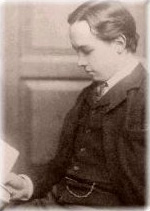
Robbie Ross

Robbie Ross was born into one of the most powerful families in Toronto. His father was a lawyer, a senator and, for a while, the President of the Grand Trunk Railroad. His mother was the daughter of Robert Baldwin, one of the most important figures in the history of our entire country — champion of Responsible Government and Canadian democracy. But Ross didn't get to live in Canada very long. Before he was two years old, his father had died and the family had moved to England.

There, Robbie Ross would soon become one of Britain's most scandalous and controversial figures. He was gay and he didn't hide it, a fact that didn't go over very well in Victorian England, where they were busy passing bigoted laws against such things. The harassment started early — he was bullied in school — and would continue throughout his life: he would be threatened with jail time, dragged into court, demonized in the press and eventually forced to leave the country altogether. During the First World War, an MP even wrote a pair of articles — one of them called "The Cult of the Clitoris," if you can believe it — accusing Ross of being part of a conspiracy of 47,000 treacherous "perverts" helping the Germans to "exterminat[e] the manhood of Britain" by turning Britons gay.

It didn't help, of course, that Ross happened to be sleeping with the most famous gay man in the entire British Empire.

Or the most famous bisexual man, anyway. Oscar Wilde was a husband and  a father when when he first met the 17 year-old Ross. And it seems that up to that point, the writer really had been attracted to his wife. But she was pregnant with their second child in 1886, and as she underwent the whole growing-another-person-inside-your-own-person thing, Wilde got seriously turned off. Disgusted even. And there was the young, attractive Ross, "determined to seduce Wilde" according to at least one biographer and already experienced from his time in boarding school. The two hooked up. Ross moved in. And the pair would remain close for the rest of their lives.

The Canadian stood by Wilde even when things started to go sour. And they did so pretty quickly once the author began an affair with Lord Alfred Douglas. Douglas led Wilde into the seedy Victorian underground of gay prostitutes and brothels. And it was Douglas' screwed up relationship with his crazyass homophobic bully of a father (the oh-so-ironically-titled Marquess of Queensbury), which eventually landed Wilde in jail. When Queensbury left Wilde a poorly-spelled calling card denouncing him as a "somdomite," Wilde sued Queensbury for libel. But when it turned out there was plenty of evidence against him, he was forced to drop the case. In the aftermath,  Ross begged Wilde to flee, but the author ignored him, was arrested, tried and eventually convicted of sodomy and gross indecency.

When Wilde got out after two long, miserable years in prison, Ross was waiting for him with a house in France. And though Wilde would forgive Douglas for his role and see him on and off over the next few years, it was Ross who was with him when he died. And it was Ross who took care of his affairs after his death, securing his legacy by buying back the rights to his works — which the author had been forced to sell during his trial — and stamping out the fake porn which was being published under his name.

For his part, Douglas went off the rails. When he wasn't accusing Winston Churchill of playing a role in an imaginary Jewish plot to assassinate the Secretary of War, he was denouncing homosexuality, attacking Ross, testifying against him in court and declaring that Oscar Wilde was "the greatest force for evil that has appeared in Europe during the last three hundred and fifty years."

-----

As a touching postscript, Robbie Ross' ashes are now at rest inside Oscar Wilde's tomb. And this story isn't the only connection Toronto has to Wilde. He came to town in 1882 as part of a year-long tour of North America that helped cement his growing fame. He lectured at the Grand Opera House  on Adelaide and the old pavilion at Allan Gardens, hated all the ads painted on our buildings, loved University College at U of T, and made fun of our yellow bricks. blogTO has got more about that visit in an article over here.

Friday, September 10, 2010

Robert De Niro Does A Shitload Of Coke And Gets Laid In The Bathroom

Robert De Niro
Okay, so things were getting a little sketchy for Martin Scorsese in the late '70s and very early '80s. He'd already released Mean Streets and Alice Doesn't Live Here Anymore and Taxi Driver—all hits—but followed them up with the giant bomb that was New York, New York. And he didn't take the failure very well. He spiraled into a vicious depression, a state of mind that wasn't helped by his already insanely high levels of cocaine use—like so high (excuse the pun), that when he ran out of blow at Cannes once, he chartered a plane to have more flown in from Paris. Another time, he over-dosed so badly that he arrived at the hospital with blood pouring from his eyes. His family fell apart. His career was a mess. His whole life was on the skids.

But then his friends stepped in to save him. First it was Robert De Niro, at his bedside in the hospital convincing him to kick coke and make Raging Bull. Scorsese threw himself into the film as if it was going to be the last movie he ever made—and he came out the other side with a masterpiece. Then, in the wake of that triumph, Roger Ebert and Gene Siskel arranged a tribute to Scorsese's films at the 1982 edition of the Festival of Festivals—the fledgling Toronto event which  would soon be renamed the Toronto International Film Festival.

It was a big deal. The festival was only a few years old, but it was already attracting the biggest names in the business. Two years earlier they'd held a similar tribute to honour Jean-Luc Godard and it had been a smashing success; Scorsese's would be no different. He was hailed as an artist and surrounded by the friends who'd come to support him—including De Niro, Harvey Keitel and Robert Duvall. Scorsese still credits the tribute as a turning point in his recovery.

But really, that whole story is just a way for me to get to tell you the bit you've been waiting for since you saw the title of this piece: To celebrate their director's new, sober success, De Niro and Keitel hit the town. According to Toronto Life, they ended up at an after-hours club "snort[ing] more coke than Tony Montana on a tear." High and horny, Robert De Niro got a film festival staffer to guard the bathroom door. Then he and "a new female friend" slipped inside to fuck.

Awesome.

-----

It was the Toronto Life article on the festival's most memorable moments that tipped me of to this, which you can read here. Oh and as a weird bonus, I should mention that at the same festival exactly 19 years later, Harvey Keitel would meet and fall in love with his second wife. On September 11, 2001. Which just so happens to be where I was that day, too, stumbling out of a morning screen at the Uptown Theatre to discover the world had gone all crazy.