Showing posts with label music. Show all posts

Tuesday, August 15, 2017

The Bizarre History of "O Canada"

"O Canada" has a long and bizarre history. The song didn't become our national anthem until 1980, but it was written a hundred years earlier: the music was composed by an American Civil War veteran from Montreal with the awesome name of Calixa Lavallée. He didn't write the tune to be Canada's national anthem, he wrote it to be Quebec's. "O Canada" was composed in honour of Saint-Jean-Baptiste Day: an ancient religious celebration that would eventually become Quebec's national holiday, deeply associated with the separatist movement.

We explore that strange story in the very first episode of the new web series I'm hosting: Canadiana. It takes us all the way from Montreal to Quebec City to Ottawa, from 1968 to 1646 to 1980, from Pierre Trudeau to the first French settlers to the FLQ. We visit riots, referendums and hockey arenas — all on the trail of the bizarre tale behind our national anthem

You can watch that first episode below. And it's just the beginning. In the months to come, Canadiana will be exploring many more extraordinary stories from the history of our country, including murders, massacres, rebellions, love triangles, secret laboratories, and more. You can watch a teaser for the series here.

To keep up-to-date with our hunt for the most incredible stories in Canadian history, you can like us on Facebook, follow us on Twitter, subscribe on YouTube, or even support us on Patreon.

Sunday, February 14, 2016

The Night Neil Young Was Conceived


It was the last winter of the Second World War. 1945. The first week of February. Far away in Europe, the Nazis were crumbling: the Soviets were closing in on Berlin; the Americans would soon be crossing the Rhine. The war would be over in just a few months. The Big Three — Churchill, Roosevelt and Stalin — were already at Yalta, meeting to decide what the world would look like when the fighting was finally done.

Neil Young's dad was one of the people doing that fighting. Scott Young was a writer by trade: a young reporter who would eventually write dozens of books and even co-host Hockey Night in Canada for a while. He first went to Europe to cover the war for the Canadian Press. His dispatches were published in newspapers all over our country. But he soon joined the Royal Canadian Navy instead, serving as a communications officer in the invasion of southern France, among other places.

The war was taking a toll, though; Young was suffering from chronic fatigue and losing weight at an alarming rate. So he was sent back to Canada for tests. That meant he would get to make a brief visit home to Toronto, where he could spend a little time with his wife Rassy and their toddler, Bob.

When he got here, he found the city covered in snow. That winter was a terrible winter — one of the worst in the entire recorded history of Toronto. One infamous blizzard in December killed 21 people. And the temperature barely ever climbed above freezing, so the snow just kept piling up as the blizzards kept coming. By the time Young came home at the beginning of February, Toronto had already seen five feet of snow that winter.

361 Soudan Avenue
And there was yet another big storm coming. As the city braced itself for the blizzard, the Youngs spent the day visiting with friends who lived in a little house near Eglinton & Mount Pleasant. (361 Soudan Avenue; it's still there today.) It was far on the outskirts of the city back then; a long way from downtown in the days before the subway. And so, as the storm descended, they all decided it was best if the Youngs stayed put. They dragged a mattress downstairs and set it up on the dining room floor.

Scott Young wrote about that night in his memoir, Neil and Me. "I remember the street in Toronto, the wild February blizzard through which only the hardiest moved, on skis, sliding downtown through otherwise empty streets to otherwise empty offices."

The Youngs' love story wouldn't last forever. In the coming years, they would often fight; she drank, he had affairs. In the end, they divorced. But on that stormy winter night in 1945, they were happy. A young wife and her new husband home on leave from the war.

"We were just past our middle twenties," Young remembered, "and had been apart for most of the previous year... We were healthy young people, much in love, apart too much. It was a small house and when we made love that night we tried to be fairly quiet, and perhaps were."

Nine months later, the war was over; peace had finally come. Scott Young was back home again. When Rassy went into labour, a neighbour drove them down to the fancy new wing of the Toronto General Hospital. It was early in the morning of a warm November day when the baby came. They named him Neil Percival Young. He would grow up to become one of the greatest rock stars in the world.

-----

Main image: the winter of 1944-45 via the Toronto Archives; other image: 361 Soudan by me, Adam Bunch.

You can find Scott Young's memoir, "Neil and Me", on Amazon here. Or borrow it from the Toronto Public Library here. You can read more about Neil Young's early life in "Young Neil: The Sugar Mountain Years" by Sharry Wilson which is on Amazon here and in the Toronto Public Library here. I first heard about this night in a review of "Rock and Roll Toronto: From Alanis to Zeppelin" by Richard Crouse and John Goddard, which is on Amazon here and in the Toronto Public Library here.

Wednesday, March 4, 2015

Marcel Duchamp & John Cage Play Musical Chess

On a cold winter's night in 1968, a phone rang in an apartment on Spadina Road. The man who answered it was Lowell Cross, an American student at the University of Toronto. He'd come north to write his thesis on the history of electronic music, studying under Marshall McLuhan among others. Soon, he would become known as "the inventor of the laser light show," but he was already experimenting with new technologies — combining electronic music with electronic visuals. One of his multimedia projects had just been featured at Expo '67 in Montreal. He was gaining quite a reputation. That's why his phone was ringing. John Cage was calling.

Cage was the world's most notoriously experimental composer. Cross was a big fan — in fact, Cage featured prominently in his thesis. Now, the composer was calling to ask Cross for help: he needed someone to build a musical chessboard.

At first, Cross said no. He was just too busy; he had a thesis to write. But then Cage said two words that changed his mind:

"Marcel Duchamp."

Duchamp was one of the most famous and controversial artists of... well... ever. When he painted Nude Descending A Staircase (No. 2) as a young man in Paris, even the jury of a cubist exhibition his own brothers were helping to curate refused to show it. ("A nude never descends the stairs," they told him, "a nude reclines.") When the painting finally did appear in public, it was part of one of the most scandalous exhibitions ever: the Armory Show in New York City, which introduced America to modern art for the very first time. There were works by Picasso, Matisse, Manet and Cézanne. But Duchamp's Nude was the biggest attraction. Thousands of people showed up to get angry at it. The New York Times called it "an explosion in a shingle factory."

But lots of other people loved it. The Armory Show inspired New York City's first modern art scene. And before long, Duchamp was a part of it himself: when the First World War broke out, he fled the military patriotism sweeping France in favour of the United States, which was still neutral in those early days of the war.

Fountain
In New York, Duchamp continued his attack on the old, conservative, academy-based art world. When one exhibition promised to display any artwork submitted to them, Duchamp sent them a urinal and called it Fountain. They refused to show it, but it was too late. Just the idea of it — the questions it raised about the definition of art and the artist and the gallery system — was a massive, giant, game-changing idea. A recent survey of five hundred art professionals found the urinal to be the most influential artwork of the twentieth century.

Duchamp wouldn't be in New York for long, though. When the U.S. joined the war, he moved on to another neutral country, heading south to Argentina. He'd spend the next few years living in Buenos Aires. And while he was there, something happened that would change his life forever:

Marcel Duchamp became obsessed with chess.

When he got back to Paris after the war, they say he wasn't even really a practicing artist anymore. Instead, he became an officially-recognized chess master. He wrote columns about the game. He played it so much his frustrated wife once glued his pieces to the board. Duchamp was only about 30, but for the rest of his entire life, until he died at the age of 81, chess would be his overwhelming passion. Not art.

"I have come to the personal conclusion that while all artists are not chess players, all chess players are artists," he announced.

John Cage, by comparison, kinda sucked at chess. But he was pretty good at composing experimental music. He came of age in the generation that followed Duchamp's — and he was deeply influenced by the French artist. "The effect for me of Duchamp's work," Cage once wrote, "was to so change my way of seeing that I became in my way a Duchamp unto myself."

There was, Cage said, "One way to study music: study Duchamp."

And so, inspired by the rebel artist, the young composer set about breaking down the walls of melody, tonality, scale and structure. He opened his music up to chance, using the I Ching and random luck to make decisions about what notes to place where. Duchamp used found objects; Cage used found sounds. His most famous piece, 4'33", was nothing more than four minutes and thirty-three seconds of a pianist not playing the piano, giving the audience a chance to listen to the ambient noise around them instead. When the piece premiered in 1952, even a crowd filled with fans of the avant-garde streamed out of the exits before it was over, muttering angrily. Forty years had passed since Duchamp's Nude, but not all that much had changed.

4'33"
By then, Cage and Duchamp had already met. They'd been introduced by mutual friends and even worked together: Cage composed music for a film Duchamp helped make. But it wasn't until the 1960s that they became friends. As Duchamp grew older, his health began to fail him; Cage realized his time was running out. And so, he came up with an idea to turn his greatest influence into one of his closest friends:

He would ask Duchamp to teach him chess.

The plan worked. At least once a once week for the rest of his life, one of the most revolutionary artists of the twentieth century sat down at a chessboard across from one of the century's most revolutionary composers. And he beat him every single time. "Don't you ever play to win?" Duchamp complained, frustrated by his own dominance. But Cage was just happy to be hanging out with one of his heroes. Besides, the composer had an even bigger victory in mind.

Everyone assumed Duchamp was done with art forever — no one, not even Cage, realized he was secretly working on a piece to be revealed after his death. So Cage found a way to lure him into one final public appearance as an artist. He would turn their usual chess game into a work of art itself.

That's why he called Lowell Cross. Cage needed a chessboard that could turn the moves of the chess pieces into music. It would require the kind of innovative, interdisciplinary design that Cross was known for. Cage already knew about Cross' work; in fact, they'd already met — they'd both contributed to a recent event in New York City billed as the musical equivalent of the Armory Show. Cross was the perfect person to build the chessboard. And as busy as he was, there was no way he could say no to Cage and Duchamp.

Still, there wasn't much time. The big game was only a few weeks away. It would happen in Toronto. Ryerson was about to host something called the Sightsoundsystems Festival — a celebration of art and technology — and the showdown between Cage and Duchamp would be the headlining event, held on the opening night. They would call it Reunion, since the spectacle would bring together a whole team of groundbreaking composers who had worked together before. Cross scrambled to finish the board in time; it wasn't done until the night before the match.

The following afternoon, a wintry Tuesday, March 5, Marcel Duchamp arrived in Toronto. As he checked into his hotel (the Windsor Arms near Bay & Bloor), he was worried. He told a friend he had no clue why he was in Canada. Cage hadn't told him anything, just that they were going to do something at Ryerson that night.

Reunion (photo by Shigeko Kubota)
What he found when he arrived was a surreal scene. Two of the greatest artists of the twentieth century took their seats in the middle of the stage at the Ryerson Theatre, bathed in bright light and the gaze of the audience. Photographers circled around them, shutters snapping; a movie camera whirred. The stage was a mess of gadgets. There were wires everywhere; a tangle of them plugged right into side of the chessboard. A pair of TV screens was set up on either side of the stage. The Toronto Star called it "a cross between an electronic factory and a movie set."

Duchamp was an old man now; he was 80. "A grave, quiet figure in a dark blue suit," the Globe and Mail called him; "his skin had the transparent quality sometimes seen in those who are at once very old and very well preserved." In fact, he only had a few months left to live. But he still played with a quiet confidence in the midst of the electronic chaos, calmly smoking a cigar and drinking wine while he studied the board, his wife Teeny sitting at his elbow with a cigarette. Across from him, his younger opponent anxiously puffed away at the cigarette holder clutched between his fingers. "Cage looked nervous," the Star said, "like a man who knows he's going to lose."

They were, said the Globe, "like figures in a Beckett play, locked in some meaningless game. The audience, staring silently and sullenly at what was placed before it, was itself a character; and its role was as meaningless as the others. It was total non-communication, all around."

It was Duchamp who made the first move. And as the players began to play, so did the music. Cross had rigged each square in the board with a photoresistor — so that every time a chess piece moved to a new square, it blocked the light and sent a signal through the wires.

Those wires were hooked up to an elaborate sound system. There was a series of speakers spread out across the theatre, along with a team of experimental composers armed with strange instruments they'd either made or modified themselves. "Tuners, amplifiers and all manner of electronic gadgetry," according to the Star. As the composers coaxed bizarre noises out of their instruments, the moves on the chessboard decided which sounds were heard and which speakers played them. They were echoed on the TV screens, too, which flickered with scrambled, oscillating images. One of Cross' prerecorded compositions was also added to the mix.

As the game progressed and the positions of the pieces became more complex, so too did the music. The room filled with "screeches, buzzes, twitters and rasps." The peak of the racket didn't last for very long, though. Before the match had started, Duchamp had given Cage a handicap — removing one of his own white knights — but it didn't make much difference. One by one, Cage's black pieces were being removed from the board. And as the pieces disappeared, the music grew simpler in response.

Reunion (photo by Shigeko Kubota)
It was all over pretty quickly. Duchamp took less than half an hour to beat Cage. They didn't even have time to finish their bottle of wine.

A second game followed; this time Cage faced off against Teeny Duchamp. They were much more evenly matched, locked in battle for hours, their stalemate stretching long into the night. The audience gradually grew tired and bored; people trickled out into the cold. After a few hours, there were fewer than ten of them left. Even Duchamp dozed off. By one in the morning, the old artist had had enough. They agreed to call it a night.

Out in the audience someone shouted: "Encore!"

The reviews the next morning weren't much kinder than the initial reviews of Duchamp's Nude or Cage's 4'33". The Star called Reunion "infinitely boring... Among great cultural events of the decade, this wasn't one of the exciting ones..." The Globe agreed: "a case of the blind leading the blind."

But the reviews, of course, weren't the point. The artists had done what they set out to do, what they had both been doing since the very beginning of their careers: breaking down the walls between life and art. It was Lowell Cross who put it best. Reunion, he said, was "a public celebration of Cage's delight in living everyday life as an art form."

Duchamp passed away a few months later. Cage followed him a couple of decades after that. But the memory of their strange chess match lives on. Nearly half a century after the two icons of the avant-garde took to the stage at Ryerson, artists are still performing their work. A version of Reunion's musical chess match was part of the Edinburgh Fringe festival in 2013. A year before that, a Chilean artist mounted his own version at the National Museum of Fine Arts in Santiago. Another version was performed in Oslo that same year. And in 2010, during Toronto's Nuit Blanche, Reunion returned to the very same stage where Duchamp and Cage had battled with queens and knights and bishops — and squeals and buzzes and rasps — all those years ago.

-----

The most invaluable source in all of this was Lowell Cross' own account of Reunion. You can read it in a PDF via JohnCage.org here.

You can also read the Star's reviews (if you have a Toronto Public Library card, I think?) here. And the Globe's here. The Globe's preview is here. And they have a scathing review of another event from the festival here. There's an ad for the festival here.

But William Littler — famous for his balanced reviews — did actually kind of get the point of the event in his review for his Star:

"There really are no objective value judgments to apply... [Cage] sees no valid distinction between art and life, between sounds suitable for making music and the sounds around us... From breaking the barriers between his art and life, the artist moves to the associated task of breaking the barriers between the various art forms... Reunion is a total affirmation, an environment which offers us sights and sounds which claim to be no more than they are... last night at Ryerson, one man's opinion was literally as good as another's."

There are more great photos of the chess match here and here.

I found lots of information about the chess match here and here and here and here and here and in French here. The CBC has a timeline of Cage's Canadian connections here.

Read more about 4'33" here and here. Or about Duchamp's Nude here. And the Armory Show here.

There's a brief biography of Lowell Cross here. And he's got lots of information on his own website, with the time of Reunion covered here.

Sunday, September 28, 2014

The Toronto Sound

This week in my column for the Canadian Music Hall of Fame, I wrote a bit about The Toronto Sound show. It was a landmark in the history of our city's 1960s music scene. A 14-hour showcase of local bands at Maple Leaf Gardens that attracted big label reps from all over the continent. They played a distinct, raw style of rock & roll that became known as "The Toronto Sound". Some of the best bands in T.O. played the show, including The Ugly Ducklings, The Paupers and The Big Town Boys.

You can check out the full story here.

-----

Photo: The 5 Rising Suns play The Toronto Sound show (via Garage Hangover)

Thursday, May 8, 2014

Glenn Gould's Groundbreaking Soviet Tour

It's Canadian Music Week this week (you can read all my show reviews over at The Little Red Umbrella), which seems like a particularly good time to share my column for the Canadian Music Hall of Fame. And it just so happens that this week I told a big, Toronto-related story: Glenn Gould's groundbreaking tour of the Soviet Union, which kicked off during this week in 1957. It was the very first time a musician from North America had played in the USSR since the end of the Second World War — an extremely important moment not just in the history of Toronto, but in the history of Russia as well.

You can read all about it in my column for the Hall of Fame here.

You can also follow the Canadian Music Hall of Fame on Twitter and like it on Facebook to make sure you catch my future columns. 

Monday, May 5, 2014

The Toronto Historical Jukebox: "Honkin' At Midnight" by Frank Motley & His Motley Crew

MP3: "Honkin' At Midnight" by Frank Motley & His Motley Crew

1960s R&B from the Yonge Street strip

Frank Motley started off his career in the United States, learning to play the trumpet from jazz legend Dizzie Gillespie. And not only that: soon, he could play two trumpets at the same time. In the late 1950s, he headed north to Toronto, where he made a name for himself playing bluesy jazz and swinging R&B in downtown clubs like the Zanzibar and the Sapphire Tavern. That made him one of the pioneers of our city's very earliest rock scene, which would soon be shaking the Yonge Street strip to its foundations, earning Toronto a reputation as the hardest rocking city of its time.

"Honkin' At Midnight" may very well be Motley's greatest track, but it's far from his only memorable tune. His version of "Hound Dog" is at least as good as the version Elvis recorded — maybe even better. And when his next band — The Hitchhikers — backed singer and drag queen Jackie Shane at the Sapphire, the result was one of the best live albums Toronto has ever produced.

-----

This is a recent post from my Toronto Historical Jukebox blog. You can check out the rest of the songs I've written about here — or any time by clicking the Jukebox tab on the menu at the top of this blog.

Saturday, May 3, 2014

The Torontonian Behind Hair — Plus: The Greatest Canadian Song of All-Time

The end of April and the beginning of May make for a pretty interesting week when it comes to the history of music in our city. And so, there were a couple of Toronto-related events that made this week's edition of my column for the Canadian Music Hall of Fame.

First off: the anniversary of the Broadway debut of the musical Hair. It started its groundbreaking run during this week in 1968. It proved to be the most controversial musical ever — full of pacifism, nudity, swearing and drug use. Some people were so upset, they tried  to shut it down while it was on tour: including someone who bombed the theatre. The Toronto connection? The music — which included iconic 1960s tunes like "Good Morning Starshine", "Aquarius" and "Let The Sunshine In" — was written by Galt McDermot, who went to high school at our very own Upper Canada College. In fact, his dad was the principal.

The second event happened during this week in 1967 when Ian & Sylvia gave a big performance at Carnegie Hall in New York. They had started out as part of the Yorkville folk scene. Their biggest hit, "Four Strong Winds", was recently chosen as the greatest Canadian song of all-time by CBC listeners.

You can read both full stories in my column here.

You can also follow the Canadian Music Hall of Fame on Twitter and like it on Facebook to make sure you catch my future columns.
 

Monday, March 3, 2014

How Toronto Helped Break Up The Beatles

At first, no one believed it was really happening. It sounded too good to be true. The Toronto Rock 'N' Rock Revival Show was going to be a massive, thirteen-hour spectacle in tribute to old-timey jukebox rock & roll. The line-up was going to feature some of the greatest rock stars that had ever lived: a mix, mostly, of old greats from the 1950s and up-and-coming young stars. Little Richard. Chuck Berry. Alice Cooper. Jerry Lee Lewis. Bo Diddley. Chicago. The Doors. Gene Vincent. Junior Walker & The All-Stars. But tickets for the festival hadn't been selling well at all. People in 1969 weren't really all that interested in rock & roll from the '50s. They were into psychedelic rock now; Woodstock had happened less than a month earlier. So it seemed pretty convenient when the rumour started: that John Lennon was going to show up with Yoko Ono, Eric Clapton and The Plastic Ono Band in tow.

Bullllllllllshit. No way they got one of The Beatles. John Lennon hadn't performed at a rock show in front of a big crowd in more than three years — not since The Beatles quit touring. When the rumour started, radio stations refused to believe it. And so did everyone else.

But then, in Detroit, a radio DJ got a hold of a recording of a phone conversation between the organizers of the festival and Yoko Ono's assistant: they were booking the plane tickets from London to Toronto. The DJ played the tape on the air and suddenly, at the very last minute, it seemed as if Lennon might actually be coming. People rushed to buy tickets. In just a few hours on the afternoon of the show, it went from a financial disaster to a sell out.

Still, the ticket holders didn't know the whole truth: even the organizers weren't completely sure Lennon would actually come. The Beatle woke up that morning at home in England, nearly six thousand kilometers away. He'd only known about the show for a couple of days, when he got a phone call from Toronto asking if he and Yoko would be willing to emcee the show. John would get to introduce Yoko to all the rock & roll heroes of his childhood and they would be able to use the show as a chance to promote peace. In fact, it would also become known as the Toronto Peace Festival. This was just a few months after they'd recorded "Give Peace a Chance" in a Montreal hotel room and just a few months before they launched their famous "War Is Over" billboard campaign. Lennon agreed. In fact, he didn't just promise to come, he promised to play.

It really was unbelievable. The Beatles were still the biggest band on Earth — just a month earlier, John, Paul, George and Ringo had finished recording Abbey Road, which would turn out to be one of the greatest albums of all-time. But the end was near. They weren't getting along like they used to: they bitched at each other in the studio, fought over the business of Apple Records, grumbled about the time Ono was spending in the studio. Lennon was looking for a new creative outlet. And the Toronto show would help give him one.

There was, however, a big problem: Lennon didn't have another band. He and Yoko had recorded together under the name "The Plastic Ono Band", but that wasn't a real band at all. It's just what they called anybody who happened to be playing with them. "YOU are the Plastic Ono Band" was their official slogan. That meant Lennon only had a couple of days to put together an entire new band from scratch.

Of course, John Lennon had an easier time finding musicians than most people would. He convinced Eric Clapton (who had played on The Beatles' White Album) to come play guitar. Klaus Voorman (who had been friends with The Beatles since their early Hamburg days and played bass in Manfred Mann) said he would come too. Drummer Alan White (who would later play in Yes) was the final piece: he agreed as soon as he realized it wasn't a prank call — that really was John Lennon on the other end of the phone.

But getting a few musicians together was one thing — actually getting on the plane and going through with his first gig in three years was another. They say Lennon was a nervous wreck. On the day of the show, John and Yoko didn't show up for the band's flight from Heathrow. The plane left for Toronto without The Plastic Ono Band on board.

That was a MAJOR problem for the festival organizers. And not just because of all the angry ticket holders they'd have on their hands if Lennon didn't show up. The promoters were much more worried about the angry biker gang they'd have on their hands.

You see, over the course of the 1960s, a biker gang called The Vagabonds had become a major force in the Toronto rock scene, doing their whole violence and drugs and horrifying misogyny and crime and riding motorcycles thing. They'd managed to sort of, um, "convince" the guys putting the show together that The Vagabonds should be allowed to escort John and Yoko from Pearson Airport (on the outskirts of the city) to Varsity Stadium (downtown, at Bloor & St. George). The Vagabonds arrived in force: 80 bikers, all of them excited to be the honour guard for one of the Beatles. They were not going to be happy if it fell through.

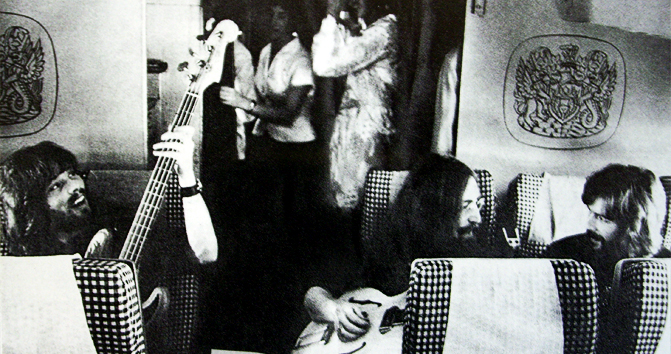
In the end, they say Eric Clapton saved the day. He got on the phone with Lennon and told him in no uncertain terms that if Eric Clapton had to be at the airport lugging around all his gear, so did John and Yoko. Lennon was finally convinced to go through with it. The band was going to be a few hours late, but the bikers were okay with that: they'd go pick up The Doors first and then make a second run. Meanwhile, The Plastic Ono Band finally got a chance to have their first ever rehearsal: on the plane, without amps or drums, struggling to hear themselves over the roar of the engines as they flew across the Atlantic on the way to their very first gig.

The Plastic Ono Band's first rehearsal

 
That wasn't the show's only last minute hiccup, either. Just a few days earlier, the promoters had managed to land another 1960s icon: D.A. Pennebaker. He was the greatest rock 'n' roll documentary filmmaker of, well, ever: the guy who had filmed Bob Dylan in Don't Look Back and made the wildly successful documentary about the Monterey Pop Festival. But there were some last minute money issues in Toronto. Pennebaker arrived at the stadium on the day of the show and started setting up his equipment — even watched as the first acts took to the stage — but he still didn't have permission to film anything. He watched helplessly as Bo Diddley — who was supposed to be one of the centrepieces of the film — began his set.

Finally, the permission came through. As Diddley came out for an encore, the cameras started rolling. So that's how Pennebaker's movie — Sweet Toronto — starts: with the sound of Bo Diddley's electric guitar playing the iconic chords from his massive, self-titled, 1955 hit. When you finally get a good look at Diddley on stage in the film, he's in a suit, guitar in hand, dancing under the hot sun with his backing band. He calls out the refrain and thousands upon thousands of people roar it back to him: "Heyyyyyyy Bo Diddley!" It's enough to give you chills. And the build up to that moment in the film is even more extraordinary: as those first chords repeat themselves over and over again, the footage cuts away to the airport, where John and Yoko and the rest of The Plastic Ono Band are arriving. They find a limousine waiting for them — along with the surprise of 80 enthusiastic bikers. As afternoon turns to dusk, The Vagabonds escort them down the 401 and into the heart of the city.

When they got to Varsity Stadium, John and Yoko headed into the dressing room; they had a few hours to wait before their turn on stage. Meanwhile, the other acts on the bill — egged on by the cameras of one of the most famous documentarians of all-time — were giving some of the most amazing performances of their entire careers.

Robert Christgau, "Dean of American Rock Critics", was there that day. And since he's one of the greatest rock writers ever, I'll defer to him:

Chuck Berry at Varsity Stadium
"The sun was fading... by the time Chuck Berry appeared. Berry is the best all-around showman in rock and roll. He is probably in his forties by now, nobody really knows, and duckwalking across the stage takes more out of him than it once did. But the cameras turned him on. Pennebaker was still contorting himself and shooting wild from the knees and belly, but Berry matched him twist for turn, and did three duckwalks, and mugged shamelessly for the cameras. In what several experienced Berry-watchers adjudged one of his finest shows ever, he stayed on for over an hour, finishing at twilight."

In fact, as the day wore on, it was clear the show was beginning to be a pretty big deal for all of the older performers. Just a decade earlier, they had been some of the biggest — and first — rock stars the world had ever seen. But now, at the end of the '60s, none of them was as popular as they had once been. Straight-up, hard-rocking rhythm and blues had been replaced by psychedelic jams. Rockers had been replaced by hippies. Now that Lennon and Pennebaker had turned the Toronto Peace Festival into something more than just a revival show, those old jukebox stars were taking full advantage. The crowd danced and laughed and sang along. It makes for remarkable footage in Sweet Toronto: those shaggy, long-haired kids of the late '60s, with their big sleeves and big hats, their vests and bare chests, smoking pot and blowing bubbles to old-timey rock & roll, shaking their hips, doing the twist, singing and clapping along to the songs that kids their age had been listening to more than a decade ago, their faces glowing. All smiles.

After darkness descended, Little Richard came out with his bouffant hair do and bright, tight, shiny, silverwhite pants, his shirt covered in mirrors. During "Good Golly Miss Molly," he leaped on top of the speakers, dancing like a disco ball, took his shoes and his necklaces off, and then hurled them all into the crowd. During "Jenny, Jenny" he stripped to the waist, bouncing, sweaty and frantic, twirling his shirt above his head before launching it out into the mass of the audience. "Long Tall Sally" was a blistering, bare-chested frenzy. He played "Tutti Frutti" twice in a row. "Rip It Up" three times. Christgau was blown away: "Little Richard, resplendent in mirrors and pompadour and with makeup covering not only his face but his neck, put on his usual orgy of self-adoration. He was magnificent." The Star called him "absolutely electrifying." The Montreal Gazette called him "rock and roll personified... You name it, he sang it — and it was all just as good live in a stadium filled with long hair and pot smoke as it was in a finished basement with white socks and smuggled beer." As Richard tore through his version of "Keep A-Knockin'," hippies made out on the grass. A Canadian flag waved above the crowd. By the end of the set, he had picked people out of the audience to dance on stage with him. "Ladies and gentlemen, you are looking at the true rock & roll!" he shouted. "The 1956 rock & roll!"

Some critics point to that day as the moment the 1950s became cool again. After appearing on stage in Toronto, the old jukebox stars, some of whom were having trouble getting gigs, started being asked to tour again. Soon, Little Richard was back on the charts; he was featured on albums by young bands like Canned Heat and Bachman-Turner Overdrive. Bo Diddley was opening for groups like The Clash as late as 1979. Jerry Lee Lewis found himself back on the charts, too. And so did Chuck Berry. In fact, he would get his first ever #1 on the Billboard Hot 100 in 1972. Today, 45 years after the Toronto Rock 'N' Roll Revival Show, Chuck Berry, Little Richard and Jerry Lee Lewis are all still touring.

And while the festival was reliving the 1950s, it was also heralding the very beginning of the 1970s.

Alice Cooper played that night too. He wasn't a big name at that point, but the Toronto Peace Festival would prove to be his most famous performance ever. His band appeared in makeup, long hair, leather and ripped stockings, playing their strange, theatrical prog-rock. At the climax of the set, they hurled themselves around the stage, tearing apart the gear, as their instruments screeched and moaned. Cooper kicked a football out into the audience, smashed a watermelon with a hammer and then heaved it, too, out into the crowd. The band broke open a few pillows, filling the air with feathers, and used big tanks of CO2 to blow them out over the audience. And then, well...

Nobody seems to be entirely sure where the chicken came from. Cooper claims that an audience member threw it on stage. Other people say the band brought it with them. Either way, you can see what happened next in Pennebaker's footage of the show: Cooper picked up a live chicken from the stage and launched it out into the crowd. "I figured: it's a bird," he explained in an interview decades later. "I'm from Detroit, I don't know, a chicken's got wings, it'll fly — and I threw it back in the audience figuring it would just fly away. Well, it went into the audience and the audience tore it to pieces."

Alice Cooper's "Chicken Incident"
By the time the newspapers hit stands the next day, some headlines were claiming that Cooper bit the head off the chicken himself and drank its blood. In the morning, he'd get a call from Frank Zappa asking him if it was true. When Cooper explained what had happened, Zappa told him, "Well, whatever you do, don't tell anyone you didn't do it." It is still, to this day, one of the most infamous stories in all of rock & roll history. Alice Cooper's "Chicken Incident" is hailed by many critics as the birth of shock rock.

Meanwhile, John and Yoko and The Plastic Ono Band had been backstage during all of this, waiting for their turn to perform. The tension was eating away at Lennon. It had been so long since he played a real show — and his first time back was going to be in front of some of his biggest musical heroes. "I threw up for hours before I went on," he admitted. (Eric Clapton later suggested that may have had something to do with all the coke Lennon was snorting.)

Finally, at midnight, it was time. The emcee for the night was Kim Fowley — a super-famous radio DJ from Los Angeles — who had an idea he thought might help to calm the Beatle's nerves. He had the stadium lights lowered, so that it was completely dark. And then he asked the crowd to light their matches. As Lennon, all long hair and shaggy beard in a white suit, stepped out onto the stage, he was greeted by a sea of flickering light. Thousands of tiny flames glowed all around the stadium. "It was fantastic," he remembered later. "The lights were just going down. This was the first time I ever heard about this — I'd never seen it anywhere else — I think it was the first time it happened."

He was still nervous, though. "We're just going to do numbers we know," he told the crowd, "you know, because we've never played together before." And then The Plastic Ono Band launched into "Blue Suede Shoes". It was big rock classics like that at the beginning of the set: the songs the band members had heard their heroes sing back when they were young — some of those heroes, the same ones who were now watching from backstage. They were the kind of songs that made Lennon want to start The Beatles in the first place. The kind of songs they started out playing in their earliest days, at the smoke-filled Cavern in Liverpool and in the rough nightclubs of Hamburg in the early 1960s. Back when it was all still fun; before everything got complicated.

It was an emotional moment. Watching from backstage, Gene Vincent had tears streaming down his cheeks. He'd first met Lennon and The Beatles back in those Hamburg days, when the Fab Four were still just starting out and Vincent was already a star thanks to "Be-Bop-A-Lula". The first record Paul McCartney ever bought was a Gene Vincent record. And as The Plastic Ono Band played those old hits, The Beatles road manger noticed the rock & roller crying. "It's marvelous," Vincent told him. "It's fantastic, man." After the show, Lennon says Vincent came up to him. "John, remember Hamburg, remember all that scene?"

John Lennon at the Toronto Peace Festival
But The Plastic Ono Band's set was as much about the future as it was about the past. The experimentation and collaboration which would define Lennon's solo career were on full display. Near the end of "Blue Suede Shoes", Yoko came out, climbed into a white bag and sat down on the stage next to John. At the end of "Money (That's What I Want)", she climbed out and handed him the lyrics. When they started into "Yer Blues", Yoko began to wail into a microphone. "It sounded as if she was crying, like a child, in fear," the Globe and Mail wrote. After a stirring, sing-along rendition of "Give Peace A Chance" — the first big public performance of Lennon's first solo song — the entire second half of the set was centered around Ono's experimental sound-making. "Yoko's going to do her thing all over you," Lennon announced. Then she began to sing the bizarre noises of "Don't Worry Kyoko (Mommy's Only Looking For Her Hand In The Snow)".

Some didn't respond well to Ono's avant-garde howling. One fan told Mojo Magazine, "People were polite. They were bewildered, but everybody knew she was an artist, she'd taken photographs of bums and things like that. We figured whatever she was doing, eventually it would end. But it didn't fuckin end." Ronnie Hawkins was there that night, too; he remembered people being a little less polite. "As hip as everyone there tried to be," he says, "Yoko was too much. 'Get the fuck off the stage,' people started to scream." Some people booed. The Star called it "excruciating... a finger nail scratching over a blackboard."

But Lennon claimed he didn't hear any of that. And Ono won some rave reviews. The Montreal Gazette called her performance "extraordinary... full of real emotion... the stunning effect of Yoko's soaring cries [were] like worlds colliding or the universe blowing apart..." The entire set was recorded and released as an album called Live Peace In Toronto 1969. It broke the Top 10 on the Billboard chart and went gold. In Rolling Stone, Greil Marcus called it, "more fun than anything [Lennon]'s done in a long while, with a great deal more vitality than Abbey Road, in fact."

The set ended with the haunting shrieks of Ono's "John, John, Let's Hope For Peace." As the song came to a close, Lennon leaned his guitar up against an amp, screaming feedback while Clapton coaxed strange noises from his own instrument. They left Yoko on stage, squawking like a bird into the Bloor Street night.

Lennon was thrilled with the way things had gone. "I can't remember when I had such a good time," he said later. "It gave me a great feeling, a feeling I haven't had for a long time." He'd been nervous and uncertain about the next stage in his life. But the show in Toronto had given him confidence. Now, he knew for sure he wanted to return to the stage. And it wouldn't be with the band he'd been part of since he was 15 years old. No less of an authority than Ringo Starr cites the Toronto Peace Festival as the turning point: John Lennon was going to leave The Beatles.

Fans at the Toronto Peace Festival
So the final seeds had already been sown by the time the last act of the Rock 'N' Roll Revival Show finally took the stage. The Doors were past their peak, too. Jim Morrison had less than two years left to live. He was already awaiting trial for indecent exposure charges; in a few weeks, he'd be arrested again for being a drunken mess on an airplane. He was run down, ravaged by alcoholism. He'd grown a beard, gained weight; one fan remembers the sound of his knees cracking as he moved around the stage that night.

But the band played a mesmerizing set. "When The Music's Over." "Break On Through." "Light My Fire." In the Toronto Daily Star, Jack Batten gushed, "Jim Morrison has so much presence, so much electricity, that he makes his rock contemporaries resemble a collection of wax dummies..." Peter Goddard agreed in the Toronto Telegram: "With [Morrison] there was a sense of melodramatic theatrics, of sensuality and poetry, of sheer power belching electronically... With an icily sleepy stare and a slow amble, he was a force to be reckoned with..."

Before long, there was only one song left to go. As Ray Manzarek's keyboards hummed darkly, the tambourine shook and the bass plucked away. Morrison leaned into the microphone, remembering how his own life had been changed by rock & roll. He shared his memories with the audience between languid, drugged-out pauses. "You know, I can remember when I was... in about the seventh or eighth grade... I can remember when rock & roll first came on the scene... it burst open whole new strange catacombs of wisdom... And that's why for me this evening it's been... really a great honour... to perform on the same stage... with so many illustrious musical geniuses."

And then, Jim Morrison began to sing. It was the only song you could imagine ending the festival with. The only song you could imagine ending the decade with, really:

"This is the end, beautiful friend. This is the end, my only friend, the end. Of our elaborate plans, the end. Of everything that stands, the end..."

It was nearly two in the morning by the time the Toronto Rock 'N' Roll Revival Show finally came to an end. In the thirteen hours since the first act took the stage at Varsity Stadium, a lot of things had changed. The '50s had been revived. The biggest band of the '60s had entered their final days. Shock rock had been born. And so, too, maybe, had the tradition of an audience lifting their matches and lighters — and someday their smartphones — into the air. It's no wonder Rolling Stone once called the Toronto Peace Festival the second most important event in the history of rock & roll. 

A week later, John Lennon told The Beatles he was done. The greatest band of all-time was breaking up. The 1960s were over. The 1970s were ready to begin.
 
-----


More of The Plastic Ono Band at the Toronto Rock 'N' Roll Revival Show: the entire set.


More Little Richard at the Toronto Rock 'N' Roll Revival Show: "Lucille", "Tutti Frutti", "Rip It Up", "Keep A-Knockin'", "Hound Dog", "Jenny Jenny", "Long Tall Sally".


More Jerry Lee Lewis at the Toronto Rock 'N' Roll Revival Show: "Hound Dog", "Mean Woman Blues", "Don't Be Cruel", "Whole Lotta Shakin' Goin' On", "Mystery Train", "Jailhouse Rock".


More Chuck Berry at the Toronto Rock 'N' Roll Revival Show: the entire set.

 You can listen to the bootleg recording of the full Doors set on YouTube here. You can watch Alice Cooper's interview about the chicken incident here. And some poor-quality footage of the set here.

You can buy the Sweet Toronto film here. A couple of other documentaries were made from Pennebaker's footage, too. You can buy Little Richard: Live At The Toronto Peace Festival 1969 here, and Chuck Berry: Live At The Toronto Peace Festival 1969 here (or borrow it from the Toronto Public Library here). You can also buy The Plastic Ono Band's 1969 Live Peace In Toronto album here.

You can read the full review of the show from Robert Christgau here. And Greil Marcus' Rolling Stone review of The Plastic Ono Band's live album from 1970 here. You can also read the full reviews from the Star, Telegram and Gazette thanks to Flickr user TheWizardofAz.

Over at blogTO, Chris Bateman has a post about the festival called "That Time Toronto Saved Rock & Roll".

I got some of the info about the cocaine, Yoko Ono, and Little Richard from the You And What Army blog here. The bit about Rolling Stone calling it the second most important event in rock & roll history came from the Globe and Mail here. Some of the quotes about The Plastic Ono Band set were found thanks to the research by John Whelan for the Ottawa Beatles Site here. You can read more about Little Richard's set on JamBands.com here. Writer Reid Dickie shared his memories of the show on his own site here. The screencap the chicken incident came from here. The screencap of Chuck Berry from here. And of John Lennon from here. The photo of the crowd was found thanks to a post by thecharioteer on UrbanToronto here.

Watching Pennebaker's footage, you can see the Royal Conservatory of Music in the distance. It's right next door to Varsity Stadium and, of course, plays it's own important role in the history of Canadian music. According to Wikipedia, former students include Glenn Gould, Oscar Peterson, Gordon Lightfoot, Bruce Cockburn, Randy Bachman (The Guess Who), Emily Haines (Metric), Owen Pallett (Final Fantasy), Richard Reed Perry (Arcade Fire, Belle Orchestre), Tegan and Sara, Sara Slean, Rob Baker (Tragically Hip), Diana Krall, Sarah McLachlan, Shania Twain, Loreena McKennitt, Paul Schaffer, R. Murray Schafer, producer David Foster, Robert Goulet, Jeff Healey, Amanda Marshall and Chantal Kreviazuk. Feist is an Honourary Fellow.

Wednesday, February 26, 2014

You Should See: The Last Pogo Jumps Again

Well, thank fuck: it seems as if people may finally be ready to start paying a bit more attention to the history of music in Toronto. It's about bloody time. Recently, there have been a whole series of popular projects exploring the city's music scenes from days gone by: from the sounds of 1960s Yorkville (Before The Gold Rush) to the rock and soul of the Yonge Street Strip (Yonge Street: Toronto Rock & Roll Stories) to 1970s Queen Street punk (Treat Me Like Dirt). Not to mention, *ahem*, the Toronto Historical Jukebox.

And now there's the epic, three-hour punk doc The Last Pogo Jumps Again. It's playing on the big screen this week for what may very well be the last time. You can catch it at the Royal tonight (Feb. 26 at 9pm) and on Sunday afternoon (March 2 at 4pm).

It's from Colin Brunton — the same filmmaker who was there to capture the legendary "Last Pogo" show at the Horseshoe back in 1978 — and Kire Paputts. But while the original was a concert film, this is a full-on exploration of the entire punk scene that flourished in Toronto during the late 1970s. In those years, our city was producing some of the very best punk rock in the entire world, with bands just as good as some of the ones getting famous in London and New York. The Last Pogo Jumps Again introduces you to many of them — The Viletones, The Diodes, Teenage Head, The Curse, The Ugly, The Scenics, The 'B' Girls, The Government, The Mods, The Demics, The Dishes... on and on and on — and to the people who helped build the scene. If you don't already know the music, the film makes for a jaw-dropping education. If you do, the footage and the anecdotes are essential viewing. Steven Leckie of The Viletones performs with blood streaming down his arms. The makers of the Pig Paper zine tell the story of stealing their first typewriter. The Curse wear bikinis made of tampons. There are brawls and drugs and police raids and outrage. And, through it all, a staggering burst of creativity.

But the documentary doesn't stop there. While the greatest punk bands from the scenes in London and New York landed major records deals, toured the world, got rich and had long careers, pretty much none of the bands in Toronto ever found that kind of financial success. The few who did make it onto major labels either got screwed over or screwed it up. And those were a very lucky few: the record industry — and many fans — just didn't take Canadian music seriously. The Last Pogo Jumps Again explores the consequences: the film's present-day interviews with the aging punks don't just look back on the scene, but also show what's happened to some of them in the 35 years since. You follow The Viletones' Freddie Pompeii as he picks up his methadone. You watch the late Frankie Venom of Teenage Head nodding off during a radio interview. In one scene, Leckie picks a fight in a coffee shop. In another, he's not even sure where he is.

Today, bands from Toronto are among the most famous bands in the world. And they aren't forced to leave the city in order to make it big. (Hell, I saw members of Broken Social Scene and The Hidden Cameras at a gig in a small club just last night.) The punks of the late 1970s don't get to enjoy it, but they helped make it happen: by staying in our city, by fighting for their rightful place in our culture, by influencing the generations who would follow. It's not an exaggeration to say they changed Toronto. And that, I think, is important to remember. The Last Pogo Jumps Again is a very good place to start.


------

Again, the film is screening at the Royal tonight (Feb. 26 at 9pm) and on Sunday afternoon (March 2 at 4pm). A DVD release is planned for the summer. The official website is here.

If you want to listen to some of the bands, I've linked all those band names above with stuff on YouTube.

Find more about the history of music in Toronto on my Toronto Historical Jukebox

Follow Colin Brunton on Twitter here and Kire Paputts here.

Sunday, February 9, 2014

Torontoist On The Toronto Historical Jukebox

A couple of weeks go, I had the chance to talk to Peter Goffin from Torontoist about the new additions to the Dreams Project I launched last year: The Toronto Historical Jukebox (the blog where I share songs from the history of the city and the stories behind them) and The Toronto Historical Bathroom Sticker Jukebox (where I stick links to those songs up in the bathrooms of music venues around the city).

The piece has some very nice things to say about the project (sample: "There are definitely worse ways to pass your time in the john."). And you can check it all out here: "Toronto Historical Jukebox Plays the Sounds of Our Past."

And, as always, you'll find the Jukebox here — or in the link in the menu at the top of this page.

-----

Photo: Jack London & The Sparrow play Chez Monique in Yorkville, 1966 (via the Clara Thomas Archives)

Friday, January 31, 2014

Six Hit Songs From 1960s Yorkville


During this week in 1967, there were six songs with ties to the Yorkville music scene sitting in the Top 50 of the CHUM Chart. From the folk of Gordon Lightfoot to the psychedelic garage rock of The Ugly Ducklings to the summertime pop of The Mamas & The Papas. I wrote about them in my column for the Canadian Music Hall of Fame this week. And since I promised to start sharing links to my Toronto history-related writing over there, you can check it out and listen to the songs right here. I also talk a bit about the very start of Neil Young's career, which began during his time in Winnipeg: between going to high school in Pickering and playing the coffeehouses of Yorkville in a band with Rick "Super Freak" James.

Tuesday, January 28, 2014

Pete Seeger & Toronto

Peter Seeger at Camp Naivelt, 1955

Pete Seeger, one of the biggest legends in the history of folk music, died last night at the age of 94. So I thought I'd take a moment to write a brief post about a couple of his connections to our city.

Once upon a time, Pete Seeger used to visit Camp Naivelt in Brampton just outside Toronto. It first opened in 1925 as a camp for young socialist Jewish kids — nearly 100 years later, it's still dedicated to that very same purpose. During the upheavals of the 1950s and '60s, Naivelt was a strong supporter of the peace movement, along with labour rights and social justice. That helped to make it a magnet for folk musicians. Some of the biggest names in folk music came to play songs for the kids who spent their summers there. Meanwhile, the anti-Communist RCMP would hang out at the front gate, taking down license plate numbers.

Phil Ochs (who wrote the famous protest song "I Ain't Marching Anymore") came to play at Camp Naivelt. So did Paul Robeson (who sang the seminal version of "Ol' Man River" in Show Boat — before he was blacklisted and targeted by Joseph McCarthy's House Committee on Un-American Activities). But the most famous visitor of all was Pete Seeger.

Seeger, who made a special effort to play at children's camps, was a frequent visitor to Naivelt. He stayed for days at time over a period that lasted all the way from the 1940s to the '80s. Even as recently as 2008, he said that he remembered Camp Naivelt fondly. "A wonderful place," he called it. By playing his songs there, he helped to inspire generations of Torontonian kids to become folk musicians. The children who went to Camp Naivelt have gone on to become some of the greatest Canadian musicians of all-time: they include people like Zal Yanovsky of The Lovin' Spoonful, Yorkville folk star Bonnie Dobson, The Travellers (who wrote the Canadian version of "This Land Is Your Land"), one of the founders of the Mariposa Folk Festival, even the guy who wrote "Hit Me With Your Best Shot" for Pat Benatar and Sharon Hampson from Sharon, Lois & Bram. She tells a story about watching Seeger sing a chain-gang song at Camp Naivelt while he chopped wood, swinging his axe as percussion. Seeger had an unfathomably deep impact on the history of music everywhere — but he had a particularly powerful influence on the history of music in Toronto.

And it wasn't his only connection to our city: Seeger's love of reading, his love of the outdoors and even his politics were inspired in part by another Torontonian: Ernest Thompson Seton. Seton had grown up exploring the wilderness of the Don Valley as a kid and went on to co-found the Boy Scouts and write children's books about animals. Seeger was given one of those books as a seven year-old boy; it sparked his passion. "I read every single book by nature writer Ernest Thompson Seton when I was a kid," he once said. More than 80 years after he was given that first book, he was still crediting Seton for the influence he had on him. Like, for instance, in this 2008 interview with Pitchfork. Or in this excerpt from an interview with David Kupfer:

"[Seton] boosted the idea of learning about the North American Indians. I learned that they shared everything that they had... There was no such thing as one person in the tribe going hungry and others having full bellies... That seemed to me to be a sensible way to live. Now today I know that anthropologists call that tribal communism. So I say that I was a Communist ever since I was age seven, when I first started reading about Seton."

-----

The photo of Pete Seeger comes from a Brampton Draft Heritage Report (PDF here) and is credited to Barbara Blaser.

Alex Ballingall has another story about Seeger's connection to Camp Naivelt here. You can watch the entire documentary episode of PBS' American Masters about Pete Seeger on YouTube here.

I wrote about the story of Zal Yanovksy and how he fell in love with Road To Avonlea's Aunt Hetty, Jackie Burroughs, while he was living in a dyer in a Yorkville laundromat here. I wrote about Ernest Thomspon Seton and his clash with American President Teddy Roosevelt here. Sir David Attenborough, the greatest of all nature documentary-filmmakers recently did a Reddit AMA in which he also credited Ernest Thompson Seton as one of his earliest influences.

Rest in peace, Mr. Seeger.