Friday, November 11, 2011

Toppy Topham Crosses The Rhine

Operation Varsity above the Rhine River

 
The war was nearly over. It had already been nine months since the Allies landed in Normandy. The 1st Canadian Parachute Battalion had been there, students and shopkeepers and dentists from places like Calgary and Saskatoon and Toronto leaping out of planes into the air above France, dropping behind German lines to secure bridges and roads. Hundreds of them had died doing it. Then, the following winter, the battalion had patrolled the freezing snows of the Ardennes Forest, resisting the brutal German counter-attack at the Battle of the Bulge. Now it was March, and the Allies had pushed all the way across Western Europe into Germany itself. But hundreds of thousands of people were still dying. And the Allies still had one more mammoth task ahead them before they could fan out across the country and overrun it: they needed to cross the Rhine River. What was left of Hitler's army was waiting for them on the other side.

The morning of March 24, 1945 saw the biggest airborne operation in the history of anything ever. Thousands upon thousands of planes and gliders took off in England and soared across the skies of Europe toward the river. They stretched out for more than 300 kilometers — the distance from London to Paris — and took two and half hours to pass by. When they got to the Rhine, tens of thousands of men leapt out of the planes, white parachutes bursting open in the morning light. They were easy targets for the bullets and anti-aircraft shells that rose to meet them. Many men died before they'd even hit the ground. Hundreds of planes fell burning from the sky.

One of the lucky men who did survive the drop was Frederick George Topham. He'd been born in Toronto during the First World War, had gone to school at Runnymede Collegiate on Jane Street, and spent some time working as a miner at Kirkland Lake. His friends called him Toppy. He was in Europe as a medic with the 1st Canadian Parachute Battalion, stitching up men on the front lines. That morning on the banks of the Rhine, they needed it. Many of the men had been shot on their way down. Their commanding officer, a guy from Winnipeg who'd won the Grey Cup with the Blue Bombers in the '30s, had already been killed. So Topham got to work, rushing from one injured paratrooper to the next: performing first aid, tending to wounds, saving lives.

It was about 11 o'clock — an hour after his jump — when Topham heard a cry for help. An injured solider was lying out in the open, bullets whizzing around him. A medical orderly ran over to help, knelt down at the man's side, and was shot dead. A second medic died the same way. Topham saw it all happen — and then rushed out to help. 

Canadian paratroopers in the drop zone
They say the air was laced with machine gun and sniper fire, but he made it all the way through to the wounded soldier, and began tending to his patient among the dead bodies. That's how Topham got shot, too. In the face. Fighting the pain, blood pouring from his mangled nose and cheek, he stood his ground, gave the solider first aid and then picked him up and carried him through the hail of bullets into the woods to safety. Then he turned around and headed right back out again, to help more of the wounded men. For the next two hours, he refused to stop working, refused to let anyone take care of his bloodied face until the entire area had been cleared of casualties.

And his day wasn't over yet. On his way back to join his company, he came across an armoured machine gun carrier that had been hit by a shell. Mortars were still landing all around it. Flames leapt from it; there were explosions. An officer warned everyone to stand back.

Topham rushed in. He found three men inside and carried each of them to safety. One died of his wounds, but the other two made it. They wouldn't be the last lives he saved that day. The medic kept working for hours.

It would take the Allies a day and a half to win the battle. Then they pressed on deeper into Germany, until they ran into the Soviet army coming the other way. The war in Europe was over. The 1st Canadian Parachute Battalion was the very first unit sent home to Canada. They arrived in Halifax on June 21st, having completed every mission they'd ever been given, and having never given up an objective they'd won.

Back in Toronto, the city had been waiting to celebrate their new hero. They threw Toppy Topham a parade down Bay Street to Old City Hall, with a hundred members of his battalion serving as an honour guard. He was asked to lay the cornerstone for the new Sunnybrook Memorial Hospital for veterans of the war. Soon, an entire post-war neighbourhood on St. Clair East would bear his name: Topham Park. And King George V would award him the Victoria Cross — the highest military honour you can get in the Commonwealth. Nearly 60 years later, when the medal went up for auction in 2004, the members of his old battalion raised hundreds of thousands of dollars to keep it in Canada. They gave it to the Canadian War Museum in Ottawa; you can see it on display.

As for Topham himself, he went to work for Toronto Hydro when he got back. That, absurdly, is how he died: in an electrical accident in 1974. Today, you'll find him buried in Sanctuary Park Cemetery at Lawrence and Royal York Road.

-----


A version of this story will appear in
The Toronto Book of the Dead
Coming September 2017

Pre-order from Amazon, Indigo, or your favourite bookseller
You can read more about Toppy Topham and the 1st Canadian Parachute Battalion here and here and here and here. There's a plaque to his memory outside the old Etobicoke City Hall. I went to his old high school, Runnymede, for a couple of years and don't remember ever having heard about him while I was there, which seems like more than a shame.

Here are some more posts for Remembrance Day:

The story of Toronto's John McCrae writing "In Flanders Fields" amidst the muck and death of Western Belgium here.
What William Faulkner was doing drunk in the cockpit on a biplane in Toronto on the day the Great War ended in 1918 here
The story of bloodshirtsy fighter pilot hero Billy Bishop here
How Canadian troops held occupy Iceland during WWII here.
What it looked like in Toronto on the day the Great War ended here.
A great photo of a women working in a Toronto munitions factory during WWII here.
The story behind on the most famous photos of all-time, "Getting Napalmed As A Child In South Vietnam" here.

Wednesday, November 9, 2011

What A $1 Bill Looked Like in 1859


During the 1800s — and even into the early 1900s — there wasn't just one national bank in Canada with the power to print money. Instead, there were dozens of "chartered" banks who had permission from the government to roll out their own bills. This is one of those, a $1 bill issued by Toronto's very own Colonial Bank of Canada. It was printed in 1859, during Queen Victoria's reign. That's her over there on the left-hand side of the money, while a woodsman / lumberjack / boy toy from a 19th century romance novel hangs out in the middle.

Finally, in 1935, we established the Bank of Canada and it began to print a centralized national currency with standardized denominations. (Which soon also meant the end of strange numbers showing up on our money, like this $4 bill from 1882.)

The Battles at St. James


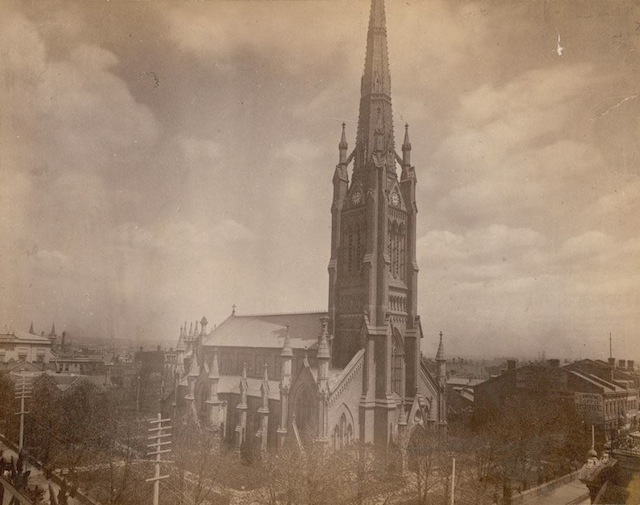
This is a photo of St. James Cathedral on King Street East, which towers above the park where the Occupy Toronto protesters are camped today, more than 100 years after this image (by old Toronto photographer guy Frank Micklethwaite) was captured. Since it's not actually in the financial district, St. James Park seems like an odd choice as the home of the protests. But historically speaking, there's some justification for it: that block of the city — from Church to Jarvis and Adelaide to King — has been at the centre of the battles over Canadian democracy for about 200 years. Last week, I wrote a piece about it for Torontoist, complete with war, riots, rebellion and plague. You can read it here.

Thursday, October 27, 2011

Photo: What Miss Toronto Looked Like in 1926


You might be familiar with this photo already, since it apparently inspired a mural on the side of the Rhino in Parkdale. It was taken at the very first Miss Toronto pageant ever, which was held in 1926, back when people made their bathing suits out of wool. The event was held at the Sunnyside Bathing Pavillion (which is still there) down by the lake. The organization of the event was eventually taken over by the Toronto Police about a decade later and moved to the CNE grounds.

They picked a Miss Toronto every year until 1991, when, it seems, we finally woke up to the whole tasteless objectification of women thing and decided maybe it was time to stop doing it. UrbanToronto has more photos of the pageants from over the years here. It's well worth a click-through and a scroll-down to get a quick and vague impression of how our city's idea of a superficial feminine ideal changed over the course of the century.

Friday, October 21, 2011

Like Washington And Jefferson Only Better

The Durham Report
This is the seventh in a series of posts about William Lyon Mackenzie, Robert Baldwin and the birth of Canadian democracy. Part one here. Part two here. Part three here. Part four here. Part five here. Part six here.

So where was I? Right, the Durham Report! After the rebellions, sick of all the turmoil in Canada, the British had sent Radical Jack Durham here as Governor General to see what could be done. By the time he returned to England a few months later, he'd been convinced by Canadian liberals like Robert Baldwin and his father William Warren Baldwin that we should have Responsible Government. Democracy. Power over own own affairs. But the British Prime Minister thought it was a crazy idea. "A logical absurdity," he called it. 

There was, however, one thing about the Durham Report that the British government did like: the racism.

Durham thought French people sucked — French Canadians included. In his report, he famously claimed that Canada was really "two nations warring within the bosom of a single state". So in addition to the whole Responsible Government thing, Radical Jack suggested that the British should try to stamp out the French influence in Canada. He recommended an overwhelming flood of English-speaking immigrants. That Francophone rights should be limited. That some of them should be taken away entirely. And that Lower Canada (Québec) should be forced to join with Upper Canada (Ontario) so that anglophones could out-vote francophones on everything. 

The British might have thought the democracy part of the Durham Report was ridiculous, but they were all over this anti-French stuff. In 1840, they passed the Act Of Union. This was a big deal. Upper and Lower Canada were combined as the Province Of Canada and renamed Canada West and Canada East. Both new provinces were given the exact same number of seats in the legislature — even though there were waaaay more people in Québec. The French were getting screwed. And it didn't stop there.

New provinces meant new elections. And the British weren't about to let French Canadians just go ahead and vote. Not without making it as difficult as humanly possible. Polls were set up in English neighbourhoods instead of French ones. Sometimes they were in completely different towns. And when francophone voters travelled those long distances in order to cast their vote, they found organized mobs of violent Tory anglophones waiting for them. If violence broke out, the army was ready to step in to protect the people who spoke English and voted conservative. A lot of people would get beaten up during this election. Eight people would die.

One of those screwed-over francophones was Louis-Hippolyte LaFontaine. LaFontaine was born just outside Montreal and grew up to become one of the leading voices in the Parti Patriote, the left-leaning, democracy-loving party in Lower Canada. (He was also a dead ringer for Napoleon — they say even Napoleon's own guardsmen once mistook him for a taller reincarnation of the diminutive dictator.) But he wasn't as radical as some of the other big name Québecois reformers. He hadn't supported the violence of the rebellions — arguing instead in favour of passive resistance and the boycotting of British goods. And while that didn't stop the Tories from driving him into exile and then throwing him in jail for a while — without a warrant or any proper charges — he was eventually released. Since the more radical Patriotes were still in prison or in exile or hanged, the job of leading the party in the new elections was left to him.

Louis-Hippolyte LaFontaine
But not even LaFontaine was going to be allowed to vote. His poll was on the far side of his riding, in a town called New Glasgow — not exactly the most francophone place in the province. When LaFontaine and hundreds of his supporters marched the ten kilometers across his riding to record their votes, one of those angry mobs of Tory anglophones was there to block the way. Some of the reformers carried clubs for protection. Some of the Tories had rifles. On the walk over, there were skirmishes. Blood in the snow. And at New Glasgow it became obvious: if LaFontaine and his supporters wanted to vote, they were going to have to fight their way through.

This, they say, was one of the defining moments in the history of our country. Electoral violence was the norm back in those days. People used to hire gangs of thugs to clear the way through the mobs in order to record their votes. And LaFontaine had hundreds of men at his side ready to do just that. But he hadn't supported violence before the rebellions and he sure as hell didn't believe in it now. He chose not to fight. Instead, he calmed his supporters down and they left without any further bloodshed, avoiding what would have been, in his words, "a massacre". Unwilling to kill for it, LaFontaine lost his seat. One of the most important supporters of Responsible Government had no voice in the new legislature.

That's when Robert Baldwin came up with a plan.

See, in those days, you were weirdly allowed to run in two ridings at the same time. It was apparently supposed to be an insurance policy for party leaders, just in case they happened to lose one. If you won both of the ridings, you could pick the one you wanted to represent; there was a by-election in the other one. And in that election, Robert Baldwin had ended up with two seats in Upper Canada. The plan was for his father, William Warren Baldwin, to run in the by-election in the extra riding, which was just north of Toronto. It had a strong base of Reform supporters — having been held by William Lyon Mackenzie back before the Baldwins ran there. But Robert Baldwin had an idea. He wrote to his father and asked him to stand aside so that LaFontaine could run there instead. His father agreed. A francophone was going to try to win an election in rural, Protestant, anglophone Ontario.

To prepare, LaFontaine moved to Toronto, into the Baldwins' house on Front Street (on the north-east corner of Bay, diagonally across from where Union Station is now). Before long, he was like a member of the family. Together, he and William Warren travelled the riding giving speeches. They argued for Responsible Government. For democracy. Against the old European idea that loyalty should mean loyalty to your race, your religion, and your Crown. The Tories and our British overlords were still fighting for that belief, but Baldwin and LaFontaine argued that our ultimate loyalty should be to be to the greater good — to our fellow human beings regardless of what language they spoke or what god they worshiped. They believed that whether you spoke English or French, you were first and foremost Canadian. And that we were all going to have to work together in order to win our freedom, our democracy and our nation away from one of the most powerful empires the world had ever seen

The voters agreed. LaFontaine won in a landslide. And Baldwin insisted that his new BFF become the leader of the new government. LaFontaine's official title would be Premier of Canada. But people called him Prime Minister.

Together, the two men set to work. The march toward democracy would be a slow one. They spent much of the next eight years building the trust between English- and French-speaking Canadians. The government was made bilingual. Baldwin sent his children to school in Québec City. Later, when the Tories pulled the same election mob bullshit with him that they had pulled with LaFontaine, Baldwin would run for election in Rimouski, in eastern Québec — and win.

Still, it wouldn't be easy. Canadian conservatives hated them — even burned Baldwin in effigy outside his home on Front Street. And in England, the liberal Whig party had just lost their election to the conservative British Tories, who hated the idea of Canadian democracy even more. When they sent a new Governor General to Canada, he had clear orders to ignore any demands for Responsible Government.

Robert Baldwin
Even worse, Robert Baldwin had begun a slow spiral into a severe, crippling depression.

He had always seemed a strange politician. He was quiet and reserved. An introvert. He mumbled his way through speeches. His skin was pale. His eyes were described as dull and expressionless. He was tall and stooped over.  They say he had "a funereal bearing". When he was young, he had fallen head over heels in love with his fifteen year-old cousin, Eliza, and their families — or, um, family — had been appalled. They sent her away for two years, but the young lovers waited and were married when she got back. For nine years, they lived a happy, love-filled life. But then Eliza died, slowwwly and painnnfully after childbirth. Baldwin was devastated. He became obsessed with her death. For the rest of his life, he carried her letters with him wherever he went. Every day, he would spend time alone in her room, which no one else was allowed to enter. Every year, around the anniversaries of their wedding and of her death, he could barely function, sorrowfully wandering the streets of Toronto, visiting the places they had shared special moments together, from their home on Front Street up to their estate, Spadina House, where she lay waiting for him in the family tomb. And now, just as Baldwin and LaFontaine were beginning to make progress, his father William Warren died too. Baldwin got worse. There were headaches. He was known to burst into tears in public. Soon, he was thinking about quitting politics altogether.

At the same time, LaFontaine was going through his own personal misery. William Warren's death had hit him hard too, but that was only the beginning. For years, he and his wife had longed for a child of their own but had never been able to conceive. They had been overjoyed when they finally adopted a daughter. But not long after William Warren died, she did too. So did LaFontaine's niece. The inflammatory rheumatism he had long been suffering from began acting up again. It kept him in bed with fevers and chest pains and excruciatingly swollen joints for weeks at a time. Sometimes months. At times, he said, he was surprised to still be alive.

But the two men carried on the fight. Even after they lost the next election. They dragged their tired bodies across the two provinces, meeting people, giving speeches, hand-writing letter after letter after letter. Baldwin outran an angry mob of club-wielding Orangemen one day; spent another being carried triumphantly through the streets of Rimouski. And it paid off. The election after that, in 1848, Baldwin and LaFontaine won a massive majority. The Tories were crushed. The time had finally come.

History remembers their government as The Great Ministry. In just a few short years, Baldwin and LaFontaine laid the groundwork for the Canada we know today. They brought in public education. An independent judiciary. Our jury system. A system for appeals. The made sure that everyone — not just the rich — had access to the courts. And that anyone — not just the rich friends of Tory politicians — could be appointed to  the civil service. They brought democracy to municipal governments. Opened our ports to ships from all over the world, instead of just British ones. They helped build our railways. Won amnesties for many of the rebels of 1837, including leaders like Wolfred Nelson and Louis-Joseph Papineau, who were finally allowed to come back home. And they took the religious King's College away from Bishop John Strachan and turned it into the secular University of Toronto.(Though they did, sadly, totally fuck up when it came to a woman's right to vote.) The impact these few years had on the history of Canada is hard to even imagine.

But none of that was as important as what they would pull off in the spring of 1849. That's when democracy finally came to Canada.

And I'll finally tell that part of the story in my next post.

-----

There are, I think, two more posts to go in this story of the birth of Canadian democracy, so I'll save some of my sources and added little tidbits for then. But a quick spoiler: though I hadn't read it until I'd written most of this post, John Ralston Saul's book on Baldwin and LaFontaine is absolutely freaking amazing and will have a deep influence on the rest of what I write about these guys. There are lots of copies of that book in the Toronto Public Library system and you can buy it right here. The fact that we don't all know this story by heart is absolutely dumbfounding. There's not even so much as a plaque at the site of Robert Baldwin's grave in St. James Cemetery. Or on the site of the house at Front & Bay. Yeesh.

I believe I shared this at the bottom of my last post, too, but you can read the full text of the Durham Report here.

Wednesday, October 19, 2011

Photo: The Old Old Mill in 1907


Here's a photo I like so much, it's on my wall at home. It's a photo of what the Old Mill looked like in 1907. It was originally built way back around 1793 as a sawmill on the banks of the Humber River, about the same time that the tiny town of York was first being carved out of the forest a good number of kilometers to the east. It was more than a century later, in 1914, that it was re-opened in its current incarnation as a hotel and tea room.

I came across the photo on Torontoist as part of an article by Kevin Plummer about Robert Home-Smith. He was a Conservative businessman/developer type person who opened the new Old Mill, and was also responsible for developing a lot of the neighbourhoods along the Humber River — as well as helping to ensure that it, unlike most of the rest of our waterways, would be lined with parkland. You can read that whole article here.

Sunday, October 16, 2011

William Faulkner Drunk In The Cockpit Of A Biplane

William Faulkner

William Faulkner liked to drink. A lot. There's an interview he did with the Paris Review — one of the few interviews he ever gave — where they asked him what he needed in order to be able to write. He answered paper, food, tobacco and whiskey. Emphasis on the whiskey. When big-deal director guy Howard Hawks asked him to write the screenplay for a movie called Road To Glory, Faulkner showed up to the script meeting with a brown paper bag under his arm. As they got down to work, he pulled a bottle of bourbon out of the bag and sliced his finger open trying to unscrew the cap. And as he bled all over the place, instead of, oh say, taking a break, he just dragged a wastepaper basket over to his chair so that he could bleed into it while he kept drinking. Yup. Dude was one badass alcoholic.

The reason Faulkner was into that kind of macho shit seems to have something to do with the fact that he grew up during the First World War. He was in high school in the States when the U.S. got involved, and his brother went off to fight in the trenches in France. Faulkner wanted to fight too, so he dropped out of school and tried to enlist in the army. But he wasn't a tall man, only about 5'5", so he was rejected. For a while, he kicked around, not quite sure what he'd do.

But then he ended up at a party where he met a Canadian officer who had an idea. He figured that Faulkner could sneak into the Royal Air Force by pretending to be British.

Now, it's probably safe to assume that Faulkner was pretty drunk at that party, but this kind of scheme was right up his alley anyway. He loved pranks. He and a friend used to get a kick out of sending famous poems into magazines and collecting the rejection slips. Notes from editors who were unimpressed with, say, "Kubla Khan", writing stuff like, "We like your poem, Mr. Coleridge, but we don't think it gets anywhere much." So Faulkner threw himself full-throttle into trying to learn how to pretend to be British. He worked with a tutor for weeks, turning his iconic Mississippi drawl into an English accent. He grew a moustache because he figured moustaches looked English. He changed the spelling of "Falkner" to "Faulkner" because he figured the letter "u" made his name look English. And he even invented a fictional English vicar he called Mr. Edward Twimberly-Thorndyke who, somehow, sent letters of recommendation from England to the British Consulate in New York City. So when Faulkner showed up in there with his English accent and his English moustache and his English letter "u", they signed him up right away. (Although, to be fair, the British had been fighting the war for three or four years at that point and they were pretty much taking anyone who wasn't already dead yet.)

U of T during WWI
And that's how William Faulkner ended up in Toronto. Our city had been taken over by the war. And by the Royal Air Force in particular. We'd already had the first airfield in Canada (in Etobicoke at Long Branch, down by the lake) and there were others all over the place: Leaside, Wilson and Avenue Road, the Exhibition... A big chunk of the University of Toronto was turned into an aeronautics school. Colleges were turned into the sleeping quarters for recruits. Tents were pitched on the lawns. Biplanes flew around all over the place. It was a pretty freaking great time for flying in Toronto. Our own Billy Bishop was the greatest fighter pilot in the world, facing off against the Red Baron and shooting down more Germans than anyone else. Amelia Earhart worked here as a nurse (at the military hospital at 1 Spadina Crescent, in the roundabout-y thing on Spadina just north of College) and was so inspired by all the flying she saw here that she decided to become a pilot herself.

It all must have seemed pretty badass to a guy like Faulkner, who soon arrived for training. This was only about 15 years after the Wright Brothers' first flight; you had to be pretty brave to get into one of those rickety biplanes on a good day, never mind when Germans were trying to shoot you out of the sky. The average lifespan for a pilot during the war was something like 11 days. Faulkner studied hard, became popular with the other recruits (he regaled them with limericks so dirty that even on the Internet every source I find says they're "unprintable"), and looked forward to the day he'd get to fight in Europe.

But that day never came. On November 11, 1918, while Faulkner was still in training, the war ended. Or as he put it: "The war quit on us before we could do anything about it." Toronto erupted into celebration. People poured into the streets. The mayor declared a spontaneous tickertape parade. Floats marched down King Street; people threw paper and (for some reason) talcum powder into the air. They parked a car on the lawn outside Queen's Park and drove over it with a tank in celebration. And at the Military Aeronautics School at U of T, they gave all the recruits the rest of the day off to go have fun.

Which for William Faulkner, of course, meant drinking.

University College, U of T, during WWI
...and flying. He packed the cockpit of a biplane full of bourbon, climbed in and took off. A lot of historians seem to think that it was the first time he had ever flown alone in his entire life. He started doing tricks. Sweeping 180 degree turns. The difficult Immelmann turn, so dangerous that the German ace it was named after, Max Immelmann, died while doing an Immelmann turn. And then, finally, a huge upside down loop which, according to Faulkner, would have been perfect. Except that right at the bottom a hanger got in the way.

Faulkner's plane smashed through the roof and got lodged in the rafters. For years afterward, the writer would walk with a limp. He'd have a crook in his nose for the rest of the life. But as he hung there upside down in the cockpit, Faulkner was unfazed. He just pulled out some more bourbon and kept drinking.

-----

I originally told this story at the Little Red Umbrella's Variety Spectacular at the Holy Oak Cafe. You can read the Paris Review interview here. And more about Faulkner's time in Toronto here and here and here. Years later, he would team up with Ernest Hemingway to work on the film adaptation of To Have And Have Not, which was the only time two Nobel Prize winners have worked on a movie together. Hemingway also lived here for a while. You can read the story about him that I told at the Little Red Umbrella Variety Spectacular hereAnd there are photos of the event here.