Showing posts with label sunnyside. Show all posts

Friday, June 8, 2012

And You Don't Even Want To Wear Pants In This Heat


You know how in old-timey novels people are always fainting all the time? Well when you see what people used to wear to the beach, it's not exactly surprising. This is Sunnyside in about 1914 or so, back when people were very clearly out of their minds. In the early 1900s, it wasn't just considered improper to show a little bit of skin at the beach in Toronto. It was totally illegal. A law passed in 1904 said that only people "wearing a proper bathing dress, covering the body from the neck to the knees may bathe at any time in the public waters within the city limits." And while people did try to fudge it a bit, if they fudged it too far they would run afoul of the Toronto Police Morality Department. (Yup, that was a thing.)

It wasn't until the 1930s that things loosened up a bit. But only a bit. The law was changed to say a bathing suit was required to "prevent indecent exposure", but no one was quite sure what that meant. The Morality Department and even the Mayor took it to mean that men had to wear tops. Hundreds of "filthy" "ape-men" were arrested for taking off their shirts at the beach, sparking legal and political battles over what exactly people were and were not allowed not to wear. (Kevin Plummer's got the lowdown over at Torontoist here.)

By 1953, a teenaged Brigitte Bardot was wearing a bikini on the beach in Cannes and things were about to get a whoooooooooole lot less stuffy. Fifty years after that, Toronto would get our very first nude beach. Hanlan's Point was officially declared "clothing optional" in 2002.

Thursday, October 27, 2011

Photo: What Miss Toronto Looked Like in 1926


You might be familiar with this photo already, since it apparently inspired a mural on the side of the Rhino in Parkdale. It was taken at the very first Miss Toronto pageant ever, which was held in 1926, back when people made their bathing suits out of wool. The event was held at the Sunnyside Bathing Pavillion (which is still there) down by the lake. The organization of the event was eventually taken over by the Toronto Police about a decade later and moved to the CNE grounds.

They picked a Miss Toronto every year until 1991, when, it seems, we finally woke up to the whole tasteless objectification of women thing and decided maybe it was time to stop doing it. UrbanToronto has more photos of the pageants from over the years here. It's well worth a click-through and a scroll-down to get a quick and vague impression of how our city's idea of a superficial feminine ideal changed over the course of the century.

Monday, August 23, 2010

Photo: Yonge and Eglinton in 1922

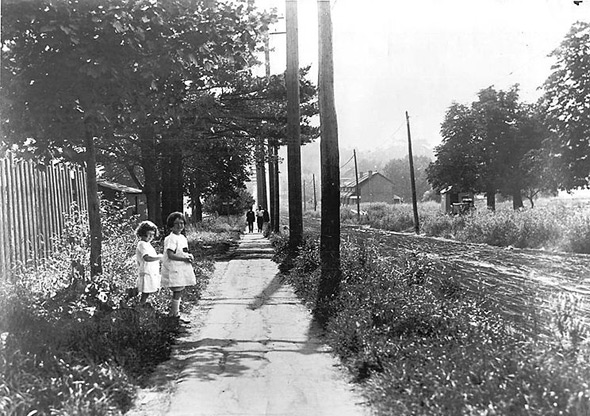
Eglinton Avenue, 1922

Yesterday, blogTO posted an article full of nice photos of Toronto during the 1920s. If you're interested in that kind of thing (and since you're reading this blog, I'm thinking there's a good chance you are), it's well worth checking out. 

The photo I've posted above was taken in 1922 looking west from Yonge Street down a very different Eglinton Avenue. It's something that I hadn't really realized until I started this research: just how undeveloped midtown was even in the early 20th century.

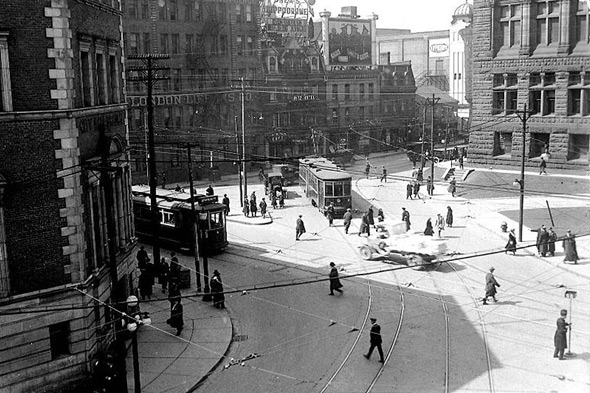
I'll post another couple of my favourites from the article below as well. The first is  looking north at the intersection of Queen and Bay in 1923. You can see Old City Hall on the right (along with the small set of steps that are still there) and, in the middle of the photo, buildings standing on what would  later become the flat expanse of Nathan Phillips Square.

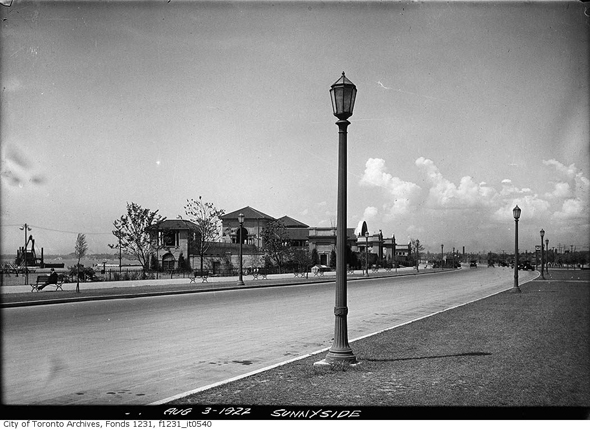
Below that is a pretty photo of Sunnyside, the brand new amusement park which had just been built on the south side of Lakeshore Boulevard. It would be demolished in 1955 by the geniuses planning the Gardiner Expressway, leaving just a few buildings behind, like the Palais Royal and the Sunnyside swimming pool. (The merry-go-round, kind of awesomely, was also saved: moved to Disneyland and renamed the King Arthur Carousel.)

But really, again, you should probably just go check out the original article.

Queen and Bay, 1923

Sunnyside Amusement Park, 1922

Monday, June 14, 2010

Marilyn Bell Kicks America's Ass

In 1954, Florence Chadwick was one of the world's most famous swimmers. The 34 year-old American had crossed the English Channel in record time. She'd been the first woman to swim the 26 miles (of shark habitat) between Catalina Island and the California coast. She appeared in movies and on television. She was a celebrity. And in 1954, that's exactly what the Canadian National Exhibition was looking for.

The CNE had started off as a farmer's fair all the way back in 1879, but in the years after WWII it was moving away from those agricultural roots toward a more modern feel. And that involved things like promoting the 1954 edition of the fair by offering Chadwick $10,000 if she successfully became the first person to swim across Lake Ontario.

Of course, the idea of a Canadian icon like the Ex offering the prize to an American seemed like an insult to some, including at least a couple of Canadian swimmers. Winnie Roach and Marilyn Bell were younger than Chadwick, but they were already accomplished long-distance swimmers. (Roach had actually been the first Canadian to swim the Channel—as she stood dripping on the beach at Dover in her bathing suit, her face all messed up from a jellyfish sting, a British customs official asked her if she had anything to declare.) Annoyed at the CNE's snub, both Roach and Bell decided that they would try the 52 km crossing at the same time as Chadwick. And so, on the night of September the 8th, all three women entered the waters of New York State and aimed for Toronto.

The water was rough. Strong winds whipped up the waves, which towered nearly five meters high. Below the surface lamprey eels—hideous and parasitic, some nearly a meter long and armed with round, toothy mouths used to latch onto fish and feed off their body fluids (their Wikipedia page actually says that, "body fluids")—were everywhere, attacking legs and arms and bodies. After only a few hours, stomach cramps forced Chadwick from the water. Soon after that, Roach followed, leaving the 16 year-old Bell as the last swimmer in the lake.

She had been pushed off course by the winds and, on at least one occasion, had been disoriented enough to swim in the wrong direction. But she kept on, through the night and into the next day. Radio stations began providing regular updates on her progress. Local newspapers printed one extra edition after another. And finally, at about 8:15 pm, nearly 21 hours after she first entered the water, a cold and exhausted Bell reached a breakwater just south of Sunnyside. She had officially become the very first person to swim across Lake Ontario.

A roaring crowd of three-hundred thousand was waiting to welcome her home. 

The CNE eventually decided to give her the $10,000 they had offered to Chadwick, but for Bell, of course, that had never been the point. "I don’t think I was sure I could make it," she later admitted, "but I wasn’t so sure Florence Chadwick could make it either. The challenge for me was to go one stroke further than the American. As corny as it sounds… I did it for Canada.”


---

You can listen to her being interviewed by the CBC after the swim, here. Or watch a different interview and some silent footage over here. Or, if you're looking to kill even more time, how about an hour-long documentary on YouTube?