Friday, September 10, 2010

Photo: Washing Cars In The Humber In 1922

Humber River, 1922

This 1922 photo of the Humber was apparently taken near where Dundas crosses the river. People, from what I can gather, have driven their cars—which would have just recently started to become really popular—into the river so they can wash them.  The other people are the swimmers who used to be able to enjoy the river before  folks started doing things like, um, driving their cars into it and it got too dirty to use.

Washing your car in a river seems like kind of a weird practice to me, but if I've learned anything in my research so far, it's that people used to do weird things. And neither Google nor the Toronto Archives website nor the book I first found the photo in seem to be able to give me much more information than that.  It's not the only photo of such a thing, though—I'll post another one below, from 1927—so I guess people were doing it for at least a few years. 

Not only does the whole thing make for some great images, but the photos also tipped me off to the existence of John Boyd, the fellow who took then. His real job was working for the Grand Trunk Railway, but he was also an amateur photographer who traveled around Ontario in the late-1800s and early-1900s. A lot of his shots are fantastic. I'll definitely be posting more of his Toronto stuff later, but you can see some of my favourite non-Toronto photos here (hunters with their kill in Haliburton in 1887) and here (a tug of war in 1910) and here (an engineer with his train in 1910).

Humber River, 1927

Tuesday, September 7, 2010

Map: Toronto in 1876

Toronto in 1876

This is hands down one of the coolest maps of Toronto ever made. A fellow by the name of P.A. Gross drew it in 1876 after having walked around the city block by block, sketching every single building, road, laneway and alley between Fort York and the Don River, from the lake right up to the Davenport escarpment. The detail is mind-blowingly incredible, so you're not going to want to just look at the small image above, you're going to want to see the fully zoomable version over here. It's amazing. 

And then, because you'll wonder how in the world such a thing was made, you'll want to head over here to read a Torontoist article all about it. And maybe even download the full-size image yourself, which you can do over here.

Sunday, September 5, 2010

Hell's Handmaiden Gets Hitched

Billy Bishop and Margaret Burden, 1917
As a teenager growing up in Owen Sound, Billy Bishop was pretty popular with the ladies. His little sister's friends would beg her to convince him to go out with them — and he'd agree... every time his sister was willing to pay him $5. One of those friends was a pretty girl from Toronto, Margaret Burden. She was the granddaughter of super-rich department store guy Timothy Eaton and her family didn't approve of the middle-class Bishop, but that didn't stop him. He fell in love at first sight and went home that night to tell his parents that he had met the girl he was going to marry.

But before he had a chance to work up to a proposal, he found himself fighting the First World War. And things quite literally didn't get off to a flying start. He was stationed in England with a cavalry unit, miserable on the ground in the rain and the mud. After a few weeks of it, he requested a transfer to the Royal Air Force; the average life expectancy for a rookie pilot was only 11 days, but as Bishop put it: "I'll bet you don't get any mud or horseshit on you up there. If you die, at least it would be a clean death."

As it turned out, he wasn't even a very good pilot. In fact, he sucked. On his first mission, he narrowly avoided getting shot down and was separated from the rest of his squadron. His commanders decided they were going to send him back to flight school just as soon as they could find a replacement.

But he was an incredible shot. In his first real battle, he downed a German ace who had destroyed 12 Allied planes. And even though he lost an engine in the process — crashing into no man's land and scrambling back across the line — the very next day, Bishop went back up and shot down another one. Before long, he was heading out alone on his own unofficial runs, and in just over a week, he had claimed his fifth victory, earning him the title of "ace" and getting the nose of his plane painted blue in celebration. Over the next few months, he would shoot down dozens more, face off against Germany's famous Red Baron, win the Victoria Cross, and find himself holding the record for downing more enemy planes than any other pilot in the Royal Flying Corps.

By the time he headed home on leave in the fall of 1917, he was an international celebrity, one of the most famous pilots in the world. In October, at Timothy Eaton Memorial Church on St. Clair just east of Spadina, he and Margaret finally got married in front of a huge crowd of family, friends and fans.

Of course, the story is much more romantic if you skip over a few details. Like the mistress Bishop kept in France. Or just how much the war had messed him up. "You have no idea how bloodthirsty I've become," he wrote in a letter to the love of his life, "and how much pleasure I get in killing Huns." After one battle, he apparently tried to bring back a German corpse as a trophy. His enemies started calling him "Hell's Handmaiden" and "The Blue Nosed Devil"; one fighter squadron put a bounty on his head.

But back home, he was a hero. And as he kept racking up victories, the Canadian government started to worry about what would happen to the country's morale if he were ever killed. So they pulled him out of action and ordered him back to England. Bishop was seriously pissed off. On his last day, he ran one final solo mission, downing five more planes in 15 minutes. It gave him a total of 72, making him the third most successful ace of the First World War — just eight victories behind the Red Baron himself.


Tuesday, August 31, 2010

Link: Old CNE Posters

The poster for the Ex in 1937

Tonight I'm heading down to the Ex for the first time in like a bazillion years, so it seems like a perfect time to direct your attention to a small online archive of old CNE posters collected by a geography professor at York University. You can check them out over here. They range from 1884 to 1939. I'm especially struck by the Communistic worker imagery in a couple of the designs from the '20s and '30s. And the way the kid in the last one looks like an enraged mini-King Kong, ready to swat a plane out of the air.

There are some other cool ones here and here and here.

Monday, August 23, 2010

Photo: Yonge and Eglinton in 1922

Eglinton Avenue, 1922

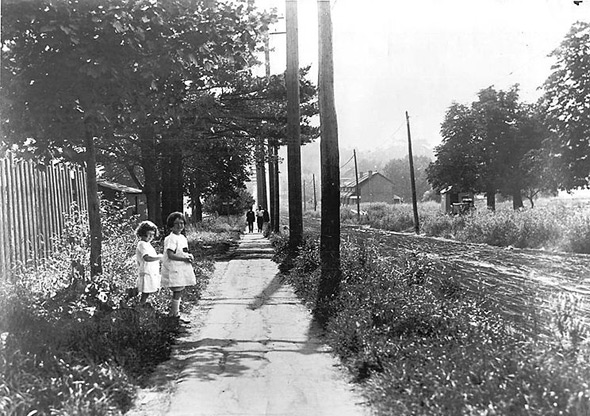
Yesterday, blogTO posted an article full of nice photos of Toronto during the 1920s. If you're interested in that kind of thing (and since you're reading this blog, I'm thinking there's a good chance you are), it's well worth checking out. 

The photo I've posted above was taken in 1922 looking west from Yonge Street down a very different Eglinton Avenue. It's something that I hadn't really realized until I started this research: just how undeveloped midtown was even in the early 20th century.

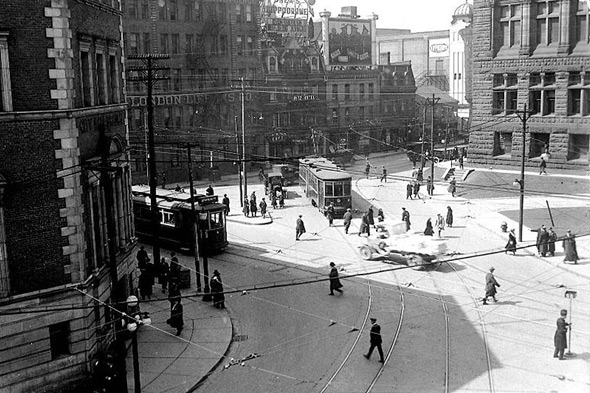
I'll post another couple of my favourites from the article below as well. The first is  looking north at the intersection of Queen and Bay in 1923. You can see Old City Hall on the right (along with the small set of steps that are still there) and, in the middle of the photo, buildings standing on what would  later become the flat expanse of Nathan Phillips Square.

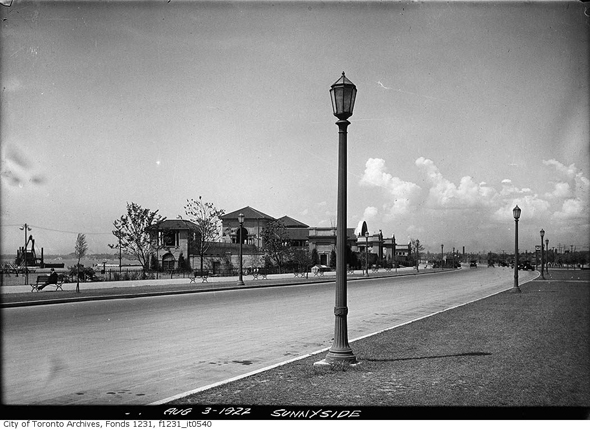
Below that is a pretty photo of Sunnyside, the brand new amusement park which had just been built on the south side of Lakeshore Boulevard. It would be demolished in 1955 by the geniuses planning the Gardiner Expressway, leaving just a few buildings behind, like the Palais Royal and the Sunnyside swimming pool. (The merry-go-round, kind of awesomely, was also saved: moved to Disneyland and renamed the King Arthur Carousel.)

But really, again, you should probably just go check out the original article.

Queen and Bay, 1923

Sunnyside Amusement Park, 1922

Friday, August 20, 2010

The Vertical Haight-Ashbury

Rochdale College back in the day
Toronto, I'm sure you'll be shocked to learn, has historically been a pretty conservative place. It stretches back to our earliest days as a fiercely Protestant, fiercely British colony. In the 1830s, Anna Jameson, a writer and wife of the Attorney-General, was already complaining about the city's "cold, narrow minds", "confined ideas" and "by-gone prejudices". And when Hemingway lived here in the '20s, the city's Protestant reserve annoyed him enough that he told Ezra Pound that Canada was a "fistulated asshole". Even Marshall McLuhan came to the University of Toronto in part because he thought the city was small-minded and resistant to new ideas—and that would give him an intellectual challenge.

But by the late '60s and early '70s that had started to change. McLuhan had his own centre at U of T. Jane Jacobs had arrived and helped to kill the Spadina Expressway. Urban advocates like David Crombie and John Sewell were being elected to city council—soon they'd be winning mayor's races, too. And a few block west of hippie-filled Yorkville there was Rochdale College.

Today, you might know it as the ugly concrete apartment building beside the Bata Shoe Museum (on the south side of Bloor just east of Spadina), but Rochdale started out life in 1968 as a radical experiment in post-secondary education. There would be no tuition, no traditional classrooms or professors. Students would plan and organize their own courses; if someone was interested in learning about something, they'd find some other students who shared their interest and maybe recruit "resource persons" to lend their expertise. They would work together to form the college's policy and administration, with each student sharing an equal vote. Even the building itself was designed with those collective principals in mind, centered around communal living spaces they called "ashrams". And out front went the "Unknown Student" statue, erected, it would seem, as a monument to all those made to suffer at the hands of a traditional education.

Over the next seven years, Rochdale became a crucible for Toronto's quickly growing arts scene. Coach House Books, House of Anansi Press and Theatre Passe Muraille were all either founded at Rochdale or strongly involved in the college during their early years. And between them, they would g on to help support a generation of Toronto's writers—Margaret Atwood, Michael Ondaatje, Timothy Findley, bp nicol, Ann-Marie MacDonald, Gwendolyn MacEwen—and are still at it today, publishing the Christian Böks, Sheila Hetis, Michael Winters and Zoe Whittalls of the world. This Magazine was at Rochdale, too. And so was Dennis Lee, who would go on to become Toronto's first poet laureate, write Alligator Pie and co-write Labyrinth and the songs for Fraggle Rock. Science-fiction author Judith Merril was there. And so was Reg Hartt, showing films at Rochdale years before he started the Cineforum out of his house on Bathurst. And as if that weren't enough, the Hassle Free Clinic started there, too.

Of course, Rochdale also had its problems. A construction strike had delayed the college's opening, forcing them to take in non-Rochdale students who weren't interested in an experimental education. Meanwhile in Yorkville, the government was actively working to—in the words of hockey-hero-turned-Conservative-politician Syl Apps—"eradicate" the hippie culture from the neighbourhood. Lots of the people driven out by new, upscale development and baton-wielding cops just moved the few blocks to Rochdale. The building, originally designed to house 840 students became home to thousands—even more people who didn't care about the college's goals.

How big a problem that was depends on who you ask. Most people tell the Rochdale story in the format of the cautionary hippie tale: idealism + drugs + time = tragedy. The college's open door policy made it easy for biker gangs and hard drugs to move in. The halls teemed with tripping young people. There were overdoses and a few people jumped or fell or were pushed from windows. Lots of people were appalled. Ontario's Minister of Housing wasn't even sure they'd be able to sell the building if they wanted to. "I think you'd have to send in the men in white coats and butterfly nets and clean the joint out before anybody could make an offer on it," he said. The press started calling Rochdale "the vertical Haight-Ashbury" and "North America's largest drug distribution warehouse".

Not surprisingly, some former Rochdale residents tend to tell the story a little differently. They suggest that having a few overdoses and suicides over the years wasn't exactly rare for a downtown apartment building. And that the college was a beacon for distressed youth—many more of whom might have killed themselves if they hadn't found a welcoming home. The speed and harder drugs were a problem; softer drug use at Rochdale had always been open, abundant and, for the most part, peaceful. Even the federal government's own Le Dain Commission, looking into recreational drug-use, had studied the college as part of its process and eventually recommended the legalization of marijuana.

Still, by 1975 the authorities decided it was time to end the experiment. Police stormed the building, literally carrying the last few stubborn students out of the college and welding the doors shut behind them. The government renamed the building after a senator, turned it into an old folks home and, just in case the elderly had any revolutionary plans of their own, promised to "carefully screen tenants to keep any possible problems out."

-----

Heck, I suppose you can even add the Toronto Dreams Project to the list of artistic endeavors that owe some kind of vague, indirect debt to Rochdale, since at least a couple of my more inspiring professors were Coach House authors. There are great photos of life at Rochdale here and here and here and here and here and there's a copy of the 1969 curriculum here. (Some of which are from the college's online museum.) On YouTube, you can watch most of Ron Mann's Dream Tower documentary about the college, but the first part has no sound, so I'm just going to link straight to the second part.

BlogTO has also written a couple of articles about the college, which are especially worth checking out because of the comment sections; they've spontaneously become a place for former Rochdale students to reconnect and reminisce. My favourite excerpt comes courtesy of Reg Hartt himself:

In Hollywood a police officer who stopped me, when finding out I was from Toronto, asked what I had done there.

"I showed films at Rochdale College," I told him.

"Do you mean Canada's Communist Training Center," he asked.

Right there I knew that if the Hollywood police knew about Rochdale it had to be the hippest place on earth.


This post is related to dream
11 Feeding The Annex
Dennis Lee, 1974

Friday, August 13, 2010

Photo: Downtown Toronto in 1857

York Street in 1857

That's York Street, looking north from King in 1857. These days, it's a just a block east of University, in the heart of downtown, lined with skyscrapers. That little white building the bottom right-hand corner of the photo is right where the Toronto Stock Exchange is now. The columned building you can see at the end of the street, at Queen, is Osgoode Hall, which was serving as the Superior Court of Upper Canada at the time. Back in those days it had two domes, only one of which you can see in the photo, but still hadn't been given the iconic black fence that surrounds it now.

You can see a bigger copy of the photo here, which I found via the always helpful History of Crime and Punishment in Canada website.