Tuesday, February 21, 2012

You Could Still See The Nothern Lights Here in 1837

Aurora Borealis by F.E. Church
In 1837, Toronto was still a very small city. There were only a few more than 10,000 people living here. And since we were still decades away from our first electric lights, light pollution at night was absolutely not even anywhere even a little bit close to what it is today. So back then, when the Sun sent a stream of energized particles into the upper reaches of the Earth's atmosphere, as it likes to do, it was much much much much easier to see the northern lights. 

That particular winter, an English writer and feminist, Anna Brownwell Jameson, was living in Toronto. And in her diary, she recorded a particularly pretty description of what she saw outside her window:

"The Aurora Borealis is of almost nightly occurrence, but this evening it has been more than usually resplendent; radiating up from the north, and spreading to the east and west in form like a fan, the lower point of a pale white, then yellow, amber, orange, successively, and the extremities of a glowing crimson, intense, yet most delicate, like the heart of an unblown rose. It shifted its form and hue at every moment, flashing and waving like a banner in the breeze; and through this portentous veil, transparent as light itself, the stars shone out with a calm and steady brightness [...] It is most awfully beautiful! I have been standing at my window watching its evolutions, till it is no longer night, but morning."

You can actually still see the northern lights on the outskirts of the GTA on very, very rare occasions. There was a massive solar storm last October, and another in August of 2010, that created auroras seen by people around the Golden Horseshoe. But in the centre of Toronto, where our lights burn bright even in the middle of the night, it seems sightings are a thing of the past.

-----

I've been reading Jameson's book about her time in Toronto, Winter Studies and Summer Rambles in Canada, which, obviously, is where I came across this. It's full of neat passages, so I'll be quoting from it some more, I think. And I already did once, here, in my post about Canada's first race riot. You can buy her book here or borrow it from the Toronto Public Library here.

The painting is by an American artists, F.E. Church. It really has nothing to do with Toronto, but you can learn more about it at the Smithsonian here.

Thursday, February 16, 2012

What Queen and Gladstone Looked Like in 1893


Wow. Well, here you go hipsters, this is what it looked liked right outside the Gladstone Hotel in 1893. The Gladstone (which isn't in this photo, just out of sight to the right) would have only been four years old when this was taken. But the awkward "Dufferin jog" was already in place -- created by the railroad running by over the bridge in this photo. The bridge only had an underpass built on Queen, not Dufferin, meaning traffic traveling up and down Dufferin had to take a detour up Gladstone Avenue instead. It would take more than 100 years for a second underpass to be built; it just opened back in 2010.

Maybe even more interesting than that, though, is that in 1893 Toronto was in the middle of switching for horse-drawn streetcars to an electric system. According to the Wikipedia, the very first electric streetcar had started running just the year before; the final horse-drawn streetcar would be retired the year after. This photo captures that brief transition. The guy in the foreground is laying down Queen Street's first streetcar tracks, with the soon-to-be-obsolete horse-drawn transportation behind him.

I came across this photo in a TTC gallery put together by the Toronto Star, which you can check out here. I'll probably post another couple of photos from it over the next few weeks.

Tuesday, February 14, 2012

Canada's First Race Riot

Slavery didn't last very long in Toronto. The man who founded our city, Lieutenant Governor John Graves Simcoe, wanted it banned from the beginning. But since some of the men he'd chosen to help him rule Upper Canada were slave owners, he was forced to compromise.

Slaves who had already been brought into the new province would live the rest of their lives as property. But no new slaves would be allowed on our soil and any new children born into slavery would be freed when they turned 25. They say it was the very first law to limit slavery in the history of the British Empire.

So when the English finally abolished it altogether in the 1830s, Toronto was already slave-free. By then, Canada had become a beacon of hope for Black Americans escaping to freedom along the Underground Railroad. And there are stories of slave hunters – men who came north to capture former slaves and take them back – being violently run out of town.

But there was still a shitload of racism in this city. And some of it came from the most powerful people in Upper Canada. Like, say, the man who the British had chosen to be the new Lieutenant Governor of the province: Sir Francis Bond Head.

Bond Head was one of the crappiest rulers our city has ever known. He was sent to Toronto (the capital of Upper Canada) from England to make progressive reforms, but turned out to be a die-hard conservative whose incompetence and corruption helped push liberals into full-blown rebellion. And just a few months before his army clashed with William Lyon Mackenzie's rebels on Yonge Street, he was behind a particularly shameful moment in the history of Canadian government.

In the spring of 1837, a man by the name of Solomon Moseby escaped from slavery in Kentucky. His "master", David Castleman, was a rich and well-connected horse breeder. (His nephew would one day lose a presidential election to Abraham Lincoln.) That May, Moseby took off on one of his master's horses and rode north. It took him two long, dangerous months to make it to Canada, but he did eventually escape across the border and into Niagara-on-the-Lake. There, it seemed like he was finally free.

But his owner wasn't ready to give up. Back in Kentucky, Castleman had the courts charge Moseby with theft – for having taken the horse. And then he followed him to Canada with an arrest warrant. Our government had already made it perfectly clear that we wouldn't return former slaves back to the United States to live a life of servitude. But we did return criminal fugitives to face American justice. When Castleman showed up in Niagara-on-the-Lake with the warrant, Moseby was immediately arrested and thrown into jail. It would be up to Bond Head to decide whether or not he'd be sent back south, where Castleman promised to make an example out of him.

Niagara-on-the-Lake rose up in protest. The town, so close to the American border, was home to lots of escaped slaves. They say a full tenth of the population was Black. Many of the town's leading citizens, including the mayor, signed a petition demanding that Bond Head release the escaped slave. Hundreds of supporters spent weeks camped outside the court house where Moseby was being held, promising that if the authorities tried to move him, they would be there to stand in the way. They even offered Castleman $1,000 to cover the cost of the horse and his travel expenses. He, of course, refused. This wasn't about the horse; this was about making sure slaves couldn't get away.

Sir Francis Bond Head
It was September by the time Bond Head announced his decision: "this land of liberty," he declared, "cannot be made an Asylum for the guilty of any colour." He ordered that Moseby be extradited back to the United States.

But it wouldn't easy. The crowd of supporters gathered outside the courthouse made sure of that. Moseby was led out of the court house in handcuffs by constables and soldiers with bayonets drawn. They loaded him into a carriage, but before it could move it was surrounded by hundreds of Black Canadians. A throng of women blocked the entrance to the bridge the carriage needed to cross, singing hymns and standing their ground. The local preacher who had been leading the protests, Herbert Holmes, got in front of the horses. Another man, Jacob Green, stuck a fence post in the spokes of the carriage's wheels.

That's when the sheriff ordered his men to open fire. Holmes was shot through the heart. Green was run through with a bayonet. They both died. Others in the crowd were slashed and bloodied. Some threw stones. Dozens were arrested. But it worked. In the confusion, Moseby slipped out of the carriage and out of his handcuffs (at least one witness claimed that his guard had left them loose on purpose; another that the blacksmith had intentionally forged them to be weak). In the days that followed, the government would put a price on his head, but years later, he'd travel to England and successfully win his legal freedom. In the end, he was allowed back to Niagara to live the rest of his life in peace.

Still, the extradition of former slaves would be an issue in Canada for decades to come. The last case wasn't heard until the 1860s, just before slavery was finally abolished in the United States. It seems that even in Canada, an escaped slave couldn't feel entirely safe.

That same autumn Solomon Moseby was fighting for his freedom, an English feminist and writer, Anna Brownwell Jameson, happened to be staying in Toronto. On a trip to Niagara-on-the-Lake, she met Sally Carter, one of the leaders of the protests. And then wrote about it:

"She was a fine creature, apparently about five-and-twenty, with a kindly animated countenance; but the feelings of exasperation and indignation had evidently not yet subsided. She told us, in answer to my close questioning, that she had formerly been a slave in Virginia; that, so far from being ill treated, she had been regarded with especial kindness by the family on whose estate she was born. When she was about sixteen her master died, and it was said that all the slaves on the estate would be sold, and therefore she ran away. 'Were you not attached to your mistress?' I asked. 'Yes,' said she, 'I liked my mistress, but I did not like to be sold.' I asked her if she was happy here in Canada? She hesitated a moment, and then replied, on my repeating the question, 'Yes—that is, I was happy here—but now—I don't know—I thought we were safe here—I thought nothing could touch us here, on your British ground, but it seems I was mistaken, and if so, I won't stay here—I won't—I won't! I'll go and find some country where they cannot reach us! I'll go to the end of the world, I will!' And as she spoke, her black eyes flashing, she extended her arms, and folded them across her bosom, with an attitude and expression of resolute dignity, which a painter might have studied; and truly the fairest white face I ever looked on never beamed with more of soul and high resolve than hers at that moment." 

----- 

The main image is a photo of the court house where the riot happened.

Anna Brownwell Jameson, while progressive for her time, could still be more than a bit condescendingly ethnocentric (as you can tell a bit from that excerpt). Her book, Winter Studies and Summer Rambles in Canada, is full of interesting stuff from her travels here in 1836-37 though, so I'm thinking I'll be posting lots of quotes from it over the next while. You can read a volume of highlights from it in the much more terribly-titled Sketches in Canada, and rambles among the red men here.

The Solomon Moseby riot happened just a few years after the first race riot in Detroit's history, which was a similar story. In that case, it was Thornton Blackburn and his wife who escaped from slavery in Kentucky and ended up settling Toronto, where he founded our city's first cab company. You can read that story here.

I wrote about Bond Head's role in the Rebellions of 1837 in a post called "Bond Head The Bonehead" here.

And you can read more information about Solomon Moseby and the riot in places I've pieced all of this together from: here and here and here and this PDF here

The photo of the court house I found here

Update: Ooh cool. Mackenzie House tweeted some related William Lyon Mackenzie quotes from his paper, The Constitution, on September 27, 1837:  "Moseby was doomed by law to perpetual slavery in Kentucky – his master might buy and sell and torture him...not because he was a criminal, but because his complexion was dark...they say he mounted his tyrant's horse and sought a home and freedom in Upper Canada. This is his crime with Sir Francis!" Mackenzie, as I briefly mentioned in the post, was in a huge political battle with Sir Francis Bond Head in 1837 that would culminate in outright rebellion that December.

Monday, February 6, 2012

Mimico Creek Looked Really Freaking Beautiful Back in 1889

This, according to me, has to be one of the most beautifully pastoral photos ever taken of Toronto. It shows us what it looked like in 1889 at the very south-east corner of Etobicoke, in the spot where Mimico Creek meets Bonar Creek just before they empty into the lake. (Well, where they used to meet anyway; most of Bonar Creek was buried in the 1950s.)

It's just a few block west of the mouth of the Humber, and these days it's easily recognizable thanks to the gleaming white arch of the Mimico Creek Bridge (which purposefully looks like a smaller version of the bridge over the Humber).

Amazingly, even though it looks like these Victorian Torontonians are in the middle of the countryside, not far to the east of them our city was undergoing a crazily enormous boom, quickly becoming a full-blown metropolis. Between 1861 and 1901 the population quadrupled from about 60,000 to about 240,000 people.

I came across this photo in the veryvery good book I'm reading at the moment: HTO: Toronto's Water from Lake Iroquois to Lost River to Low-flow Toilets. So you can probably expect a bunch of water-related posts over the next little while. You can also buy the book for yourself from Coach House here or borrow it from the library here.

Tuesday, January 31, 2012

What Yonge & Queen Looked Like in 1915ish


This photo is looking north up Yonge Street from Queen Street in 1915ish. I don't have too terribly much to say about it, but here are a few tidbits. The entire left-hand side of the photo, the west side of Yonge, is now, of course, the Eaton's Centre. But the H. Knox and Company store you see here (which eventually become Woolworths) is still partially preserved. Across, the street from it, on the very right of the photo is the Bank of Montreal building which is also still there on the north-east corner of the intersection, though now it has a giant glass tower rising out of it. Behind that, you can see part of the sign for the Heintzman piano company, which will get its own post someday. Theodore August Heintzman came to Toronto from Germany in the 1800s and built a piano in his kitchen. When he sold it, he used the money to start his own company, which soon gained an international reputation for producing some of the highest quality pianos in the world. In 1915, Heintzman had recently bought the building you see here to use as a head office; we still call it "Heintzman Hall". These days, it's a heritage property and home to a Home Sense.

Thursday, January 26, 2012

The Very First Black Hole Ever Discovered Was Discovered At U of T

HDE226868

This is a photo of a star called HDE226868. It's a blue supergiant, more than 20 times as big – and hundreds of thousands of times as bright – as the Sun. And it's relatively close by, in the same part of the galaxy as we are: a thin line of stars in between two of the great spiraling arms of the Milky Way. Still, it takes light 1600 years to reach us from there. It's about 16 quadrillion kilometers away. And you can't see it with your naked eye; you need at least a small telescope to glimpse it through the clouds of interstellar gas and dust that stand between us and it.

But as far as X-rays go, this patch of sky is a shinning beacon. The signal we get from it is stronger than pretty much anything else we can see. And since blue supergiants don't give off that kind of radiation, we know those X-rays must be coming from something else. Something powerful. Something we call Cygnus X-1.

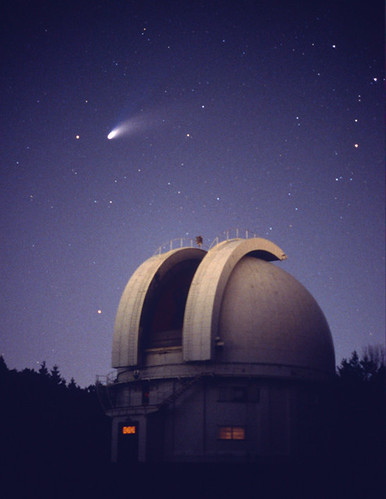
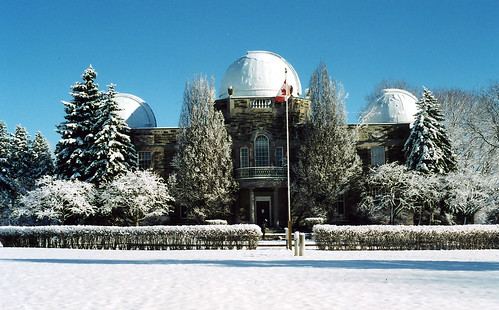
Charles Thomas Bolton figured that Cygnus X-1 was probably another star. He was just a young astronomer back in 1971, having come up from the States to do his postdoc at the University of Toronto. He spent a lot of his time at the school's astronomy facility in Richmond Hill: the David Dunlap Observatory. The beautiful stone and dome complex had been built in the 1930s on an estate of nearly two hundred acres just north of the city. It housed the second biggest telescope in the world when it opened. William Lyon Mackenzie King was here to help celebrate the opening. Stuttering King George and his wife Elizabeth (who you might know better as the Queen Mum or Helena Bonham-Carter in The King's Speech) made sure to see it on their trip across Canada. It's still the biggest telescope in the country. And when Bolton pointed it at Cygnus X-1, he was hoping to find evidence of a neutron star.

Neutron stars are small but incredibly heavy, the dense remnant of a bigger star after it dies in a supernova explosion. They give off X-rays like crazy. And early observations seemed to confirm Bolton's suspicions: he could see that HBE226868 was wobbling slightly, which meant that there must be a massive source of gravity nearby. If that source of gravity was a neutron star, he'd have discovered a binary system: two stars orbiting around each other. That would have been a pretty exciting find for the young astronomer, who was particularly interested in those systems.

But Cygnus X-1 was no neutron star. After a couple of months spent collecting data at the Dunlap Observatory, Bolton began to suspect the truth about what he'd actually found. HDE226868 was orbiting something massive, alright. But it was orbiting it at an incredible speed: more than 200 times the speed of sound. That meant Cygnus X-1 was much smaller and much denser than a neutron star. It meant Cygnus X-1 was a black hole.

It seems that once upon a time, there was a really, really, really, really, really BIG star. Like more than 40 times bigger than the Sun big. For most of its life, it did what all stars do: crush hydrogen atoms together, the immensity of its gravity causing nuclear reactions to fuse them into helium. In fact, it was so big that eventually it was fusing that helium into even more complex elements, stuff like carbon and neon and oxygen and silicon. That's where all that stuff comes from: every single atom of it in the entire universe forged within a star. By the end of their lives, the very biggest stars make an even more complex and heavier element: iron. And so, at the centre of this particular gigantic star, a great iron core was building up. In the end, it was so heavy that its atoms couldn't support its own weight anymore. It imploded. The enormous mass was crushed down into a tiny space. It became so dense, and its gravity so strong, that nothing that came close to it could ever escape again. Not even light. It became a black hole.

An artist's conception of Cygnus X-1 and HBE226868
HBE226868 whips around it at a staggering velocity of once every five or six days. A long tail of material gets sucked from the star down toward the black hole, heating up into a disc of plasma as it nears the event horizon – the point of no escape. That, it seems, is where all those X-rays are coming from. Meanwhile, two long jets of particles are sent streaming away at the near the speed of light.

Now, no one had ever found a black hole before. Einstein's theories of relatively – and the quantum physics that followed – had predicted them, but there were still plenty of scientists who didn't believe they existed at all. Bolton knew that going public with his discovery was going to be risky. It would either make or break his career. It wasn't until a pair of scientists in England – and then another one in the United States – seemed to confirm his findings that he published his paper. Even then, it was extremely controversial. People put forward plenty of arguments against it. It even became the subject of a famous bet between Stephen Hawking and another physicist, Kip Thorne. Hawking, who had long believed in black holes, says he was 80% sure that Bolton was right, but bet against it anyway. That way, even if he'd been wrong about black holes his entire career, he'd still win something.

But he wasn't wrong. In 1990, enough evidence had finally piled up to convince Hawking without a doubt. Bolton had been right. Cygnus X-1 was a black hole. The David Dunlap Observatory had discovered an extraordinary phenomenon never seen before. Hawking broke into Thorne's office at night and signed the bet. Thorne had officially won himself a one-year subscription to Penthouse magazine.

-----

These days, black holes are widely-accepted as an important part of our universe. And supermassive black holes, waaaay bigger than Cygnus X-1, are believed to sit at the centre of many galaxies — including the Milky Way. 

Tom Bolton still works as a professor at U of T, though they recently kicked him out of the David Dunlap Observatory so they could sell it to a developer, who has promised to preserve the facility itself. It's still open to the public, which more details on their webiste here.

As for the open land around it? That's currently being fought over at the Ontario Municipal Development Board. The developer wants to build on it, while community groups want to preserve the parkland, protect local wildlife (like this baby coyote, awwwww), and ensure that light pollution doesn't interfere with the view through the telescope. You can read about the fight here and support those who want to protect the land here.

In the late-'70s, Toronto prog-rockers Rush wrote a 28 minute-long, two part song about Cygnus X-1, which spanned two albums and tells the story of a spaceship captain who is pulled into the black hole only to find himself in the Greek mythological home of the gods, Olympus, where he settles a conflict between Apollo and Dionysus, and then becomes a god himself. You can listen to the whole crazy thing right here.

Also interesting: the Dunlap's telescope mirror was carved from the same glass the famed Palomar telescope in California, which inspired an Italo Calvino book and a Rheostatics song.

 You can read a bit more about Tom Bolton in the U of T paper here.

And here's a sketch of the plans for the observatory, drawn in 1933, along with a couple of my favourite more recent photos of it:


Thursday, January 19, 2012

People Were Pissy About Toll Roads Back in the 1800s, Too

Toll house, Dundas & Bloor
So that's what a toll house in Toronto looked liked in the 1800s. This one was apparently on the northeast corner of Bloor and Dundas. But the very first one we ever built in the city was on Yonge Street, at King, back in 1820. That's when there were still only about a thousand people living here, in a tiny little town nestled between the lake and the ancient, wild forest that had stood on this land for thousands of years. It hadn't even been three decades since the first British soldiers showed up to chop down trees and clear space for Upper Canada's new capital. So, in those days, even Yonge Street and King Street were just rough, muddy paths. And their intersection, now at the bottom of a canyon of skyscrapers, wasn't much more than a crossroads in the countryside, a few blocks west of the heart of the town. Building those early, rudimentary roads and keeping them passable was a pretty big job; collecting tolls helped pay for it. Soon, there were toll houses all over Toronto.

That, of course, pissed some people off. And some of them tried to avoid paying tolls altogether. That was a common practice back then — and not just in Toronto. Cornelius Krieghoff, one of the most famous and iconic early Canadian artists, has a whole series of paintings about people whipping their horses up to full speed so they could blow past toll houses without paying. Back in Wales, people rioted, men dressing up as women to destroy toll-gates under the cover of darkness. They called themselves Rebeccaites after Genesis 24:60: "And they blessed Rebekah and said unto her... let thy seed posses the gate of those which hate them."

In Toronto, things could get tense too. Along Queen Street, there was an important toll house built at what's now Ossington but was then the end of Dundas, the major road stretching west all the way to London. To the south of the toll-gate was an enormous military reserve – and Fort York. So if you wanted to sell stuff to the British army, you had to pay a toll every time. This especially annoyed one particular lumber dealer. His men frequently got into fights with the toll collectors – sometimes there was violence. Finally, the lumber dealer bought the plot of land to the east of the toll house and built his own damn path through the woods. That way, his men bypassed the toll-gate altogether. He called his new road Rebecca Street, in honour of those Welsh rebels. And it's still there today, branching off Ossington a block north of Queen.

There were toll houses in Toronto for nearly a hundred years. But by the end of the 1800s, the last of them were closed as part of an agreement to let people from outside the city sell their goods at the St. Lawrence Market free of any fees. (You can still visit one, though: the "tollkeepers cottage" was recently restored on the north-west corner of Davenport and Bathurst.)

Fifty years after that, some people, including our mayor, would propose building the Gardiner Expressway as a toll road, but that part of the plan never happened. So it wasn't until the 1990s that Bob Rae's provincial government would build the 407 to raise funds for the government (and then Mike Harris' government would essentially just sell it off to a private consortium to help balance his budget just before an election). It was the first toll road in the world without gates, operating electronically instead. And it was the first toll road in Toronto in more than century.

-----

 You can read more about the Tollkeepers Cottage here. I found the painting of the toll house on the Toronto Public Library website here. You can read a bit about Rebecca Street and the connection to the Rebeccaites here. And more about those Welsh rebellions here and here. I was first tipped off to the story by the book Toronto Street Names: An Illustrated Guide to their Origins, which my parents got me for Christmas and rules. You can buy it yourself here or get at the library here.