



Showing posts with label baseball. Show all posts

Thursday, March 29, 2018

The Con Artist Harry Decker — Toronto's First Star Baseball Catcher

Toronto was celebrating. The 1887 baseball season was over, and the city had just won its first championship. The team was packed with beloved stars, like the ace of the pitching staff, Ned "Cannonball" Crane, who led Toronto to victory in 16 straight games to finish the year. The names of the players who'd pulled off the feat would be revered in the city for decades to come. But one of them wasn't quite what he seemed.

In the midst of all those beloved heroes was one notorious villain. The man who crouched behind the plate all season was more than just a baseball player. He was a con artist — and his life was about to take a terrible turn. His name would soon appear in the papers under much more dismal circumstances: as the subject of manhunts and of courtroom dramas, locked away in prison cells and in lunatic asylums, earning a reputation as "one of the most dangerous men in the country."

Toronto's star catcher was a criminal.

---

Harry Decker grew up in Chicago. As a teenager he was already among the most promising young prospects in the city. A catcher with "a good, strong, accurate arm... solid batting and capable defensive work," he signed his first professional contract before he turned 20 and quickly broke into the Major Leagues with the Indianapolis Hoosiers. His future seemed incredibly bright.

But it didn't take long for the first signs of trouble to appear. Decker seemed determined to squander all that promise.

He didn't even finish his first season with Indianapolis. He quit halfway through a game, when a couple of players from a new, rival league showed up. "Oh Deck!" they called out to him, "Over here" — quite literally waving a wad of dollar bills in the air.

They say it only took three or four innings for Decker to make his move. In the sixth, he let the ball hit him in the finger so he could claim he was injured and pull himself from the game, never to return. He raced off to Kansas City to play for a new team in the new league — leaving a pile of debts and unpaid bills behind him.

It was a costly decision. The new league quickly failed and Decker was blacklisted from the Majors for a season. The season after that, he was back in trouble again: suspected of throwing a game for gamblers. The crime was never proven, but he committed three errors and let himself get thrown out at the plate during the supposedly fixed contest — enough to make people very suspicious.

And so, as the 1887 season approached, Decker found himself looking for a job.

He got three offers: the teams in Washington, Rochester and Toronto all wanted him. So he said yes to all three. And then tried to cash all three of their cheques.

His scam didn't work — thanks to a mistake that was either breathtakingly dumb or breathtakingly brazen. He tried to cash two of the cheques at the same time, with the same banker. The banker caught on quickly: he'd been on the Board of Directors for the Washington team.

Still, Decker wasn't ready to give up yet. Next, he tried to cash three more cheques from three other teams by pretending to be three different catchers. This time, his fraud was uncovered because he gave a fake address for one of his alter-egos. When the team showed up at that address, they found nothing there but a vacant lot... and Harry Decker pacing up and down the street, waiting for his cheque to arrive in the mail.

Even then, he didn't admit his wrong-doing. His first line of defence was simple: no one, he claimed, could possibly be that stupid. When that failed, he concocted a new fraud, claiming that there were two Harry Deckers who were both catchers in the Major Leagues. That one didn't work either.

Suddenly, teams were getting cold feet. His offers were quickly drying up.

And so that's how he ended up in Toronto.

---

1887. Toronto was booming. New railroads were bringing new Canadians into the city every day. The population was skyrocketing. New businesses and entertainment ventures were being opened constantly. And now, for the first time ever, they included a professional baseball team.

The Toronto Baseball Club had played their very first season the year before, in the city's first baseball stadium, which stood overlooking the Don Valley at the corner of Queen & Broadview — right across the street from the spot where the Broadview Hotel now stands.

It was originally known as the Toronto Baseball Grounds, but it would soon be nicknamed Sunlight Park in honour of the nearby Sunlight Soap Works factory. Spectators could walk in off Queen Street or ride up in their carriages and park their horses on the grounds. Admission was a quarter — plus an extra dime or two to sit in the best seats in the house. The sheltered grandstand had enough room for more than two thousand people, and there was standing room for another ten thousand beyond that. A sellout at Sunlight Park meant that about 10% of the entire population of Toronto was at the ballgame that day.

Baseball was still brand new back then. So new, in fact, that some of the rules were still being developed. That year, a pitcher needed four strikes to get a batter out. He could throw five balls before giving up a walk, and he was allowed to hit the batter too. Umpires could ask players and fans for advice. Sacrifice flies didn't exist. And for the very first time, every home plate would be made of rubber instead of marble.

The Toronto team played in one of the minor leagues: the International League. But they were still stacked with star players and memorable characters. 

There was outfielder Mike Slattery, fast as anything. He stole 112 bases that year, setting the International League record, which still stands to this day. And as if that wasn't impressive enough, he and another one of his teammates — August Alberts — both had a batting average over .350.

The backup catcher was George Stallings. He would go down in history as a Major League manager — "The Miracle Man" who led the hapless 1914 Boston Braves from last place to a stunning World Series sweep — and is credited with being the first manager to successfully use a platoon.

The star of the team was Cannonball Crane, the ace of the Toronto pitching staff; one of the game's first big power pitchers. His fastball was the fastest in the game. And he combined that blistering speed with a "deceptive drop ball" that baffled opposing hitters. It was a deadly combination.

With Decker behind the plate catching him, Cannonball carved up opposing hitters. He would win 33 games for Toronto that year — more than any other pitcher has ever won on any Toronto team — with a 2.49 ERA. And he was one of the best hitters in the league that year, too, finishing with a .428 batting average — still considered to be the best batting average by a pitcher in professional baseball history.

Together, they battled for first place all through the summer, neck and neck with the teams from Newark and Jersey City. The decisive day came on a Saturday afternoon in September: a double-header against their rivals from Newark. Cannonball pitched both games and hit the walkoff home run to win the second, propelling Toronto into first place. They would never relinquish that lead: they won every single game for the rest of the year. 16 in a row.

Harry Decker had helped to bring our city its first baseball championship.

---

He would play even better the following season, hitting .313 as the Toronto Baseball Club finished in second place. But even after he'd established himself as a star in Toronto, it was his life off the field that made Harry Decker truly remarkable.

For one thing, he was an inventor. He came out of his time in Toronto having produced a design for a new kind of padded catcher's mitt — the same basic idea that is still being used today. He enlisted a business partner and together they applied for a patent, working in the offseason to prepare for production. It would prove to be an incredibly lucrative idea, but Decker was never a patient man. He nearly lost the patent entirely when he didn't bother to pay the necessary fees. And in the end, he sold off his interest in the new glove for $50. The rights were bought by Al Spalding's company: the sporting goods king who founded the National League would go on to manufacture the glove for years to come.

And that may not have been Decker's only sucessful invention. That same winter, he might have invented a new kind of turnstile, which quickly became the standard in ballparks, fairgrounds and racetracks across the country. But the details aren't clear. The New York Sporting Times accused Decker of ripping off the design: they claimed he stole a turnstile from the Philadelphia Phillies' ballpark, filed off the name of the original inventor, replaced it with his own, and then tried to sell the turnstile back to the Phillies as a completely new design.

And whether or not that story was true, it certainly wasn't out of character. Harry Decker was a con artist with an impressively long rap sheet.

Over the years, he faced criminal charges over and over again. He was arrested for stealing from teammates. And from his roommate. He was arrested for stealing a suit of clothes, and for stealing a bicycle, and for stealing a horse. He forged a cheque to pay his tailor, another to pay his grocer, a third to pay for a fancy hat for his mistress, and many more beyond that. He forged the signatures of Al Spalding and of the owners of the Phillies. He got caught counterfeiting money — and then forged the signature of the U.S. Marshal who arrested him for it.

As one Pinkerton detective put it, "I know it is customary in some circles to always describe a criminal as 'one of the most dangerous men in the country.' But this trite phrase well applies to him." The Chicago Tribune complained, "Decker's hallucination is that he owns the City of Chicago. He was in the habit of entering saloons and ordering wine for everybody present and then walking out with the belief that the place belonged to him and he could give away his own wares if he saw fit."

He used so many fake names that eventually the police admitted they didn't even know what his real name was anymore. All they knew for sure was that he grew up in a respected, wealthy family... in Pittsburgh. Which wasn't true at all.

Decker gave many explanations for his litany of crimes. He blamed some of them on getting hit in the head by a baseball. Others on getting kicked in the head by a horse. Some, he blamed on the stress of having a wife and a young child. Some, on insanity — the courts institutionalized him twice, but both times the doctors at the asylum found nothing wrong with him and released him back onto the streets again.

Once, Decker convinced a judge to send him to a particular prison of his own choosing by claiming he was dying of tuberculosis — which he miraculously recovered from as soon as the decision was handed down. On another occasion, when arrested for forging yet another cheque, he evaded jail time entirely by pointing out that when he signed the person's name, he'd spelled it wrong — so he couldn't possibly be guilty; he hadn't actually signed their name at all. At one point, he even seems to have had an operation to remove a cyst from his forehead — so it would be harder for witnesses to identify him.

On the occasions when he wasn't able to talk his way out of trouble, his rich parents were usually there to bail him out or to hire the best lawyers to defend him.

But his personal life, as you might imagine, did suffer.

Decker was married young, during the year he was blacklisted from the Major Leagues: to Annie Burns, a fifteen year-old girl he'd gotten pregnant. He had never been faithful to her: as his baseball teams toured from city to city, he quickly gained a reputation as a serial womanizer. The Philadelphia Inquirer called him "The Don Juan of the Diamond." And their marriage suffered another crushing blow when their two year-old daughter — who by all accounts, Decker was truly devoted to — died at the end of his last season in Toronto. Things seem to have gotten even worse after that. 

In 1891, Decker tried to marry a second woman under a fake name. But his fraud was quickly uncovered and he was charged with bigamy. It wasn't the last time he'd be caught trying to do something similar. And on another occasion, he was charged with statutory rape, having seduced an underage girl.

"I think I am a most unfortunate man," he once complained. "It seems to me that if I merely look at a girl she fancies me so much that a breach of promise suit is the result."

Annie divorced him in 1896. 

His baseball career was even shorter than his marriage. He played only two and a half seasons after leaving Toronto. His talent was undeniable and he got another shot at the Majors, but his actual results were usually mediocre and his teams' patience with his criminal behaviour quickly ran out. He was released by the New Haven Nutmegs halfway through the 1891 season — after he was arrested for the second time in just a few months. "If Decker had pursued a different course," an old manager once lamented, "he would now be in demand by the best clubs in the country." Instead, he would never play professional baseball again.

He did turn up on a diamond at least once more, though. In 1915, Sporting Life magazine stumbled across an interesting photo. It had been sent to the manager of the Los Angeles Angels as a thank you: the Angels had sent free uniforms to the team of prisoners who played baseball at San Quentin Prison. The autographed photo showed the full roster of inmates, and there among them was the star of the team: a catcher who looked awfully familiar. He was older now, and calling himself Earl Henry Davenport, but the face was unmistakable: it was Harry Decker. His life of crime had caught up with him yet again. He's thought to have spent a total of twelve years in prison.

But after that, he disappears from history. After being released from prison in October of that year, Harry Decker essentially vanished. Historians from the Society for American Baseball Research have spent decades trying to track him down, searching for any mention of him in the years after his stay at San Quentin. But it's not an easy job: Decker is thought to have used anywhere between fifteen to twenty aliases during his life; it was once said he "changes his name each time he boards a train." 

And so, no one knows how Harry Decker spent his final days, when he died, or where he is buried. It seems as if the ultimate fate of the one most notorious ballplayers in the history of Toronto will forever remain a mystery.

-----

Peter Morris' book, "Catcher: The Evolution of an American Folk Hero" has an absolutely fantastic chapter about Harry Decker. You can find it on Google Books here. I first learned about him in a passing mention in the awesome book "Baseball's Back In Town: From the Don to the Blue Jays A History of Baseball in Toronto" by Louis Cauz. You can buy it here or borrow it from the Toronto Public Library here.

I wrote more about Cannonball Crane here — and he gets a chapter in my Toronto Book of the Dead, too, which you can buy at your favourite Toronto bookseller (or from Amazon here). I also wrote about the 1887 championship team here.

"Bob Lemke's Blog" shares Decker's story here. He's also mentioned in "Big Sam Thompson: Baseball's Greatest Clutch Hitter" by Roy Kerr on Google Books here. And Sportsnet lists him as one of "The Greatest Mysteries in the History of Sport" here. Baseball History Daily has more about him here. And Goodwin & Co does here. His Baseball Reference stats page is here (though sadly, they don't have the numbers for that 1887 team). The Vintage Baseball Glove Forum has images of the glove he invented here.


Tuesday, November 7, 2017

My Favourite Memory of Roy Halladay

My favourite memory of Roy Halladay came on a night he lost an unimportant game in the middle of an unimportant season.

The Jays were playing the Red Sox, who would win the World Series that year, and Doc was coming off his worst start in years... but we weren’t worried. This was Roy Halladay. He never had two bad starts in a row. And to top it off: as we waited in line at the box office, a couple in Red Sox gear came up to us and randomly offered us their extra tickets. Two seats just a couple of rows behind the Jays dugout. The best I’ve ever had. For free. To see Doc.

This. Was. Exciting. We were going to get to watch the best pitcher of his generation ply his craft from just a few meters away.

But this was not Doc’s night.

He gave up a run in the first and then struggled even more mightily in the third, giving up six more runs — including a three-run homer to Mike Lowell. The unthinkable was happening. Two bad starts in a row. Something was very wrong.

But Doc kept battling, got out of the inning, and managed to make it through five before his night was over.

The next day, he was rushed to hospital… and straight into surgery. Turns out Roy Halladay’s appendix was ready to burst. He’d pitched five innings of major league baseball with an organ inside his body on the verge of exploding. And of course when the doctors told him he’d miss 4–6 weeks, he had his own ideas. He was back on the mound just three weeks later.

Put his name on the Level of Excellence, retire his number, and stick a statue outside the Dome. My god, he’ll be missed.

Monday, April 11, 2016

Toronto's Depression-Era Beauty Queen Baseball Star

Women have been playing baseball for as long as anyone can remember. And for much of that time, they've been playing despite the men who've tried to keep them off the field. In baseball's early days, women were told they were much too fragile to swing a bat or field a grounder. Even Al Spalding, founder of the National League, said that women were welcome to sit in the stands and cheer for the men — but that was it.

"Neither our wives, our sisters, our daughters, nor our sweethearts may play Base Ball on the field," he declared. "Base Ball is too strenuous for womankind, except as she may take part in the grandstands, with applause for the brilliant play, with waving kerchief to the hero of the three-bagger." As if playing shortstop were somehow more physically demanding than, oh, say, giving birth.

Luckily, many women ignored that poor, Victorian advice. And when you look through the oldest photographs in the Toronto Archives, you'll find plenty of women already there, playing baseball on diamonds all over our city. They were forming their own teams and their own leagues, drawing their own big crowds.

By the time the end of the 1930s rolled around, even Miss Toronto herself was getting in on the action.

In 1937, the winner of the annual beauty pageant was a teenage softball pitcher from the Beaches. Billie Hallam's grandmother convinced her to enter the competition. And so, on a hot Saturday afternoon in July, she raced down to the Exhibition Grounds in her swimsuit, where she would parade before a panel of judges and 20,000 spectators. When Hallam was announced as the winner, the Mayor of Toronto presented her with a sash. She was only 17 years old, but in heels, she was already taller than he was.

That night, as the new Miss Toronto, Hallam was due to appear at a celebratory banquet at the Royal York Hotel. But she had business to take care of first. She rushed straight home from the pageant to change her clothes. From there, a police escort rushed her through the streets to Kew Gardens, where her ball team was playing a big game. She cheered them on from the bench in her evening gown, and then raced back downtown to the banquet.

The next morning, she woke to find the press knocking on her door, eager to interview the city's newest beauty icon. One journalist asked a version of the same question men had been asking for years: should women really play sports? Hallam's answer was pretty much the exact opposite of what Spalding had said decades earlier. "[T]here is nothing like exercise and sport," she told the reporter, "to make a girl a real lady."

The next time she returned to the mound, a crowd of more than 10,000 people was there to see her pitch — the most ever for a game at Kew Gardens. At one point, she even did a photo shoot wearing her uniform. You can find those photos in the Archives, too.

Hallam was far from the last Toronto woman to make her mark in the baseball world. More than 10% of the players in the famous All-American Girls Professional Baseball League — the league from A League of Their Own — were actually Canadian. In real life, the star of the Rockford Peaches wasn't Geena Davis, it was Gladys Davis, an interior designer from Toronto. Today she's in the Canadian Baseball Hall of Fame and part of a display in Cooperstown.

Decades later, when the Blue Jays brought Major League Baseball to town, The Toronto Star's Alice Gordon made history as the first woman to cover an MLB beat. And she did it in the face of misogynist discrimination from many men in the game, including some of the Jays' own players. When the team travelled to Texas, the Rangers banned all reporters from the clubhouse just so they wouldn't have to let her in.

We have, of course, come a long way since then. Today, there are countless women writing about the game. This season, Jessica Mendoza is breaking new ground as a broadcaster with ESPN's Sunday Night Baseball. And on the field, players like Mo'ne Davis are making history, too. But we still have a long way to go. We were reminded of that just last week, when Blue Jays manager John Gibbons claimed that a new rule is making the sport less manly. "You know what, maybe we’ll come out wearing dresses tomorrow," he complained. "Maybe that’s what everyone’s looking for."

Well Gibby, Billie Hallam proved it nearly 80 years ago: you can sure as hell wear an evening gown and still be a damn fine ballplayer, too.

-----

Kevin Plummer has a much more detailed post about Billie Hallam's crowning as Miss Toronto here. Lots of my info comes thanks to him. And from old articles from Toronto Star written by another one of our city's pioneering journalists, Alexandrine Gibb.

The full, misogynist Al Spalding quote can be found in the book "Playing America's Game: Baseball, Latinos and the Color Line", which you can find on Google Books here. And I originally found part of it in another book, "Stolen Bases: Why American Girls Don't Play Baseball" which is also on Google Books here

The Rhino, in Parkdale, has a Miss Toronto mural overlooking the patio, as The Vintage Inn points out here.

Photo of Billie Hallam via the Toronto Archives. 
 

Friday, October 16, 2015

On José Bautista's Bat Flip & The Making of History in Toronto

The very first legendary home run ever hit in Toronto was hit in 1887. More than a century before Joe Carter's famous World Series walk-off at the SkyDome, Cannonball Crane hit a homer into the sky above the Don Valley to end a game at Sunlight Park. It was made all the more impressive by the fact that it came during extra innings in the second game of a double-header — and that Crane had pitched all 20 innings for the Toronto Baseball Club on that Saturday afternoon. Those two victories sparked a 16-game winning streak that brought Toronto our very first baseball championship.

Cannonball Crane fell apart soon after, spending his final days as a broke, unemployed, depressive alcoholic who met his end by drinking a bottle of a chloral at a seedy motel across the lake in Rochester. But thanks to that home run, he'd already written his name into the history of our city. He was a hero. For decades to come, his name would be mentioned with reverent awe on a regular basis in Toronto. And it still is from time to time. In fact, next summer Heritage Toronto will unveil a new plaque on the spot where Sunlight Park once stood — at Queen & Broadview — and it will include a mention and a photo of Crane. Nearly 130 years after his game-winning home run, the name of Cannonball Crane is still remembered. 

Those opportunities for quasi-immortality don't come along very often. Extraordinary talent has to conspire with a strange amount of luck in front of an unusually large audience. Cannonball Crane was one of the greatest pitchers and sluggers of his time, brought to the plate at just the right moment in front of a record-setting crowd — about 10% of the entire population of Toronto was at Sunlight Park that day.

On Wednesday night, one of the greatest sluggers of our time came to the plate at the SkyDome during one of the strangest innings in baseball history — and more than 10% of the entire population of Canada was watching.

Ned "Cannonball" Crane
No one ever expected José Bautista to become a superstar. He was drafted in the 20th round. He spent years as a forgettable utility infielder. In his rookie season, he got released and traded four times in just a few months — from one terrible team to another. Finally, Pittsburgh traded him to Toronto for a middling minor league catcher.

The Blue Jays didn't expect him to become a superstar either. But after making an adjustment to his swing — adding a higher leg kick to change his timing — that's exactly what he did become. In 2010, he hit 54 home runs — a dozen more than anybody else hit that year. And he hasn't looked back. Since Bautista became a slugger, no other slugger has hit more home runs than he has. On Thursday, Joe Posnanski of NBC Sports called Bautista's career "one of the most bizarre and inspiring stories in the history of baseball."

They say that thanks to his early struggles — along with facing the subtle and not-so-subtle racism of the old school baseball establishment — the Dominican Bautista has always played as if he has something to prove. And that, in part, is what makes him such a perfect fit for Toronto.

Torontonians, too, feel like we have something to prove. We always have. It's our infamous colonial mentality, stretching all the way back to our early days as a muddy outpost on a distant, snowy frontier. Our city was founded as a capital — but a tiny capital, thousands of kilometers away from the heart of the British Empire, dwarfed by the American juggernaut to the south. We've always been secretly ambitious (our founder, John Graves Simcoe, wanted Toronto to become a city so awesome that Americans would beg to be let back into the British fold), but we worry that if we're honest with ourselves we'll find that we're largely irrelevant. That inferiority complex was already in place long before Cannonball Crane stepped to the plate on that September afternoon in 1887. It was, I suspect, part of what drove the crowd's frenzied reaction when he crushed his game-winning home run.

As the fans lifted Crane onto their shoulders and paraded him out of Sunlight Park and onto Queen Street, the team's owner scrawled a triumphant message on the scoreboard: "CITIZENS, ARE YOU CONTENT? TORONTO LEADS THE LEAGUE."

The crowd went nuts. In Toronto, we're always looking for signs that we really do deserve our place as one of the most important cities on the continent — even if those signs come from something as random and trivial as the outcome of a baseball game. On that day, it must have felt like our city was finally coming into its own: a booming metropolis in a brand new nation... and now a famous baseball star to call our own and a fresh championship pennant to hang in our brand new stadium.

It felt like that again in the early 1990s, as Joe Carter wrote his own name into our city's history with his own game-winning home run. We were still a booming metropolis, even bigger now, playing on a bigger stage, proud of our country and our place in the world — of peacekeeping and of Heritage Minutes and of top spot on U.N. lists — with yet another fresh pennant hanging in yet another brand new baseball stadium. Those Blue Jays seemed like us, the way many in Toronto were beginning to see themselves back then: cosmopolitan, multicultural, professional, elite...

Joe Carter's walk-off
But since then, of course, our sports teams haven't exactly helped with the whole inferiority complex thing. At this point, no North American city with as many major sports franchises as we have in Toronto has gone this long without at least appearing in a championship final. And while sports are supposed to be a silly distraction that ultimately doesn't mean much, it does do something to a city — there is a civic toll that comes with being a city full of Leafs fans. Especially here, where sometimes it still feels like we live on a forgotten, snowy frontier, where blowing a 4-1 lead late in a hockey game seems to confirm our worst fears about ourselves and our place in the world. Even if that's really quite silly.

In Toronto, we're used to getting our hopes up only to have them immediately dashed in spectacular, heartbreaking fashion. We're used to feeling embarrassed by our sports teams, and that feeling spills over into other areas, too: we're embarrassed by our sports teams, by the new name of the SkyDome, by our transit system, by our racist Prime Minster, by our crack-smoking mayor...

For most of this last week, it felt like it was all happening again. As far as talent is concerned, the Blue Jays are a juggernaut — some say they're one of the greatest baseball teams ever assembled. But in a short playoff series bad luck can bring down even the greatest of baseball teams. And Toronto is used to bad luck.

When the Jays lost the first two games at home, there was a familiar sinking feeling. And as they clawed their way back into the series over the next two games, hitting thrilling home runs in the distant heat of Texas, we were reluctant to get our hopes up again, a city full of Charlie Browns sick of trying to kick that football.

For most of Wednesday night, in the sudden death of Game Five, it seemed like we were right to be suspicious. For the first six-and-a-half innings, disaster loomed: the Jays quickly went down by two runs, fought their way back to tie the game with a mammoth home run from another lovable Dominican slugger — Edwin Encarnación, walker of the parrot, bringer of hat tricks — and then, almost immediately, there was that bizarre fluke throw by Canadian catcher Russell Martin, the ball clanking off Shin-Soo Choo's bat and sputtering down the line as the go-ahead run dashed home from third base. This was how we were going to end our season? This confusing mess of a run?

The aftermath of the Martin-Choo play
The pathetic, childish, dangerous rain of beer cans that followed wasn't just about that specific moment in the game, it was about 20 years without a Blue Jays playoff appearance, about half a century without a Stanley Cup, about Vince Carter and Chris Bosh and Andrea Bargnani. It was disgust not just with the umpires or the rules, but with all of sports in general, with the whole concept of random chance, with the very nature of the universe itself...

But luck is a funny thing.

Baseball — like life — is at its best when it feels like magic. It's a long, unfathomably complicated thing, a baseball season. It's impossible for a mind to wrap itself around all the pieces and interactions involved: the hundreds of players, the thousands of games, the hundreds of thousands of individual plays that can be broken down into millions of distinct elements. It can be an awe-inspiring experience, watching it all unfold. The almost quantum-like fluctuations of individual pitches gradually build themselves into larger structures over the course of the summer, into the baseball equivalent of planets and stars: games, seasons and careers. At times, luck and human agency come together in a sequence of events that seems to defy the laws of reason and logic and chance — producing moments that seem nearly miraculous. Cannonball Crane hits a walk-off home run on a day he pitches 20 innings. Joe Carter becomes the only player in the history of the sport to hit a come-from-behind home run to win the World Series. We are reminded that amazing, wonderful, stupid, lucky things can happen. Even to us.

No one has ever seen anything like that seventh inning. Posnanski called it, "The craziest, silliest, weirdest, wildest, angriest, dumbest and funniest inning in the history of baseball... There has never been an inning like it." That thought has been echoed over and over again in the hours since it happened — not just by people in Toronto, but by baseball fans everywhere. On her CBS Sports Radio show, Amy Lawrence promised, "We will never forget what happened in that seventh inning." It was, without a doubt, one of the most memorable 53 minutes in the entire history of a sport that has kept records since before the American Civil War... since before Canadian Confederation... since before Toronto's first skyscraper was so much as a glint in an architect's eye... Talent and good luck conspired on an international stage in a way that no one has ever seen before. And it happened in Toronto. To Toronto.

Russell Martin tries to throw the ball back to the pitcher and it hits Choo's bat. The Rangers make three straight errors. José Bautista comes to the plate...

No current Blue Jay has been a Blue Jay as long as José Bautista has. No Blue Jay has waited longer for the team to make the playoffs. For years, Jays fans have worried that bad luck and the lack of talent around him would conspire to waste his years here. That he might be doomed to share the fate of Carlos Delgado and Roy Halladay: superstars who never played a playoff game with a blue bird on their chest, who will always be remembered fondly in Toronto, beloved, but never had a chance to write their name into the history of our city in one instant, with the indelible ink of a miracle in the postseason or during the final days of a pennant race. They never had the chance to do something extraordinary with our whole city watching, our whole country, our whole continent... the kind of moment that turns you into more than just a baseball player, that makes you, in some very small way, immortal.

Historica bait
You could see it all in that bat flip. The years of struggle. The years spent playing for Toronto teams that were never quite as good as he was. The years of being ignored in favour of the Red Sox and the Yankees. The years without a playoff berth. Gone. In an instant. In one blazing miracle of a home run.

Gone for Bautista and gone for Toronto, too. We're happy to have that bat flip speak for all of us — which is part of why I think we fell so deeply and instantaneously in love with it. It's the swagger Toronto is learning to have. The swagger we want to have. The Toronto of Drake and of #The6ix. Of a giant TORONTO sign in Nathan Phillips Square. Of one of the world's great music scenes. Of Nuit Blanche and First Thursdays and Friday nights at the ROM. Of a city that is slowly realizing — despite all the real and serious problems we still have to solve — that we really are pretty great, y'know.

We're a city coming to the realization that more than 200 years after Simcoe founded our muddy town, we actually have lived up to our original promise. And if we still doubt it, Bautista's home run gives us another chance to get the external validation we want so badly. For this moment at least, we can forget about them flying our flag upside-down and about whatever that moron Harold Reynolds thinks. Toronto, the scribes of NBC Sports remind us as they marvel at that miraculous inning, is "one of the world’s great cities." 

Now, whatever happens, we'll always remember these Blue Jays. These Jays who feel in so many ways like a reflection of our own city. Of the Toronto of 2015. A cast of characters drawn together from all over the world. Truly multicultural. The young, social media savvy pitcher from Long Island. The rookie closer, the youngest player in baseball, who quit school as a kid to work in the fields of Mexico. The oldest player in baseball, who loves the members of his fan club so much that he goes to their weddings. The quiet Dominican slugger who bought an entire block of his poor, corrupt-sugar-company-run hometown so the residents can still keep living there. The nerdy veteran pitcher from Nashville who has battled depression and struggled with childhood sexual abuse, who mastered the mysterious art of the knuckleball when it seemed like his career was over. The Australian reliever. The Japanese goofball. The Italian-American who spent years playing in the independent leagues before finally getting his big break. The catcher from Montreal who gives press conferences in both official languages. The rookie from Mississauga who runs like the wind. The whiz-kid Canadian General Manager, who got his start with the Expos, who is usually reserved but who parties, gets drunk, and curses with his team on the night they clinch the pennant.

Even if the season ends next week, even if the Jays don't win another game, people in Toronto — people all over Canada — will remember Donaldson and Tulo and Price and Sanchez and Papa Buehrle and Pillar's crazy catches and the beaming smile of Ben Revere...

But most of all we'll remember José Bautista. And that bat flip. And the night it felt like Toronto really could live up to our spot on the big stage. Just like we did in 1993. And in '92. And in 1887.

-----

Rob Ford was there, by the way, somewhere at the Dome as Bautista's home run soared into the seats. But we weren't embarrassed — we were too busy celebrating, we didn't even care. 

You can my full, illustrated history of baseball in Toronto here. I've also written more about the tragic tale of Cannonball Crane here, the 1887 Toronto Baseball Club here, plus the greatest second baseman in Toronto (who isn't who you think it is) here, Babe Ruth's first home run here, and Joe Carter's World Series-winning dream here.


Tuesday, October 13, 2015

The Tragic Tale of Toronto's First Big Baseball Star

The bases were loaded. It was the bottom of the eight. This was it: first place was on the line. Toronto and Newark headed into that Saturday afternoon battling for the lead in the International League — along with the team in Jersey City. With only a couple of weeks left in the 1887 season, every win was vitally important. And with only an inning left in their second game of the day, Toronto was losing to Newark by three runs.

That's when Ned "Cannonball" Crane came to the plate. He was the ace of the Toronto pitching staff; a giant of a man: big and tall and impossibly strong. He once threw a ball more than 400 feet — a world record; impressive even by today's standards — and he could throw a ball faster than anybody else could, either. He was one of the game's first big power pitchers. He combined the blistering speed of his fastball with a "deceptive drop ball" that baffled opposing hitters. It was a deadly combination. He won 33 games for Toronto that year — more than any other pitcher has ever won on any Toronto team.

And he could hit, too. Crane was one of the best hitters in the whole league that year. His .428 average is still considered to be the best batting average by a pitcher in professional baseball history. (If he'd hit that in the Majors, it would put him sixth on the all-time list for any position.) On the days when Crane wasn't pitching, he was in the outfield or at second base so they could keep his bat in the line-up.

On that Saturday afternoon in September, Crane had already done more than his fair share. Toronto and Newark were playing a double-header — two games at the Torontos' new stadium at Queen & Broadview, on a spot overlooking the Don Valley.

It was originally known as the Toronto Baseball Grounds, but it would soon be nicknamed Sunlight Park in honour of the nearby Sunlight Soap Works factory. Spectators could walk in off Queen Street or ride up in their carriages and park their horses on the grounds. Admission was a quarter — plus an extra dime or two to sit in the best seats in the house. The sheltered grandstand had enough room for more than 2,000 people, and there was standing room for another 10,000 — a capacity not that much smaller than a Leafs game at the Air Canada Centre today. But the stadium had never seen attendance like this. Those two games against Newark drew a record-setting crowd.

In the first game, Crane pitched all nine innings, keeping the Newark hitters at bay while the Toronto bats smashed their way to victory. The final score was 15-5.

But there was still one more game left to win. And now the Torontos had already used up their ace. The scheduled pitcher for the second game was a fellow by the name of Baker — and as the first pitch drew near, he was out on the field, getting ready just as everyone expected.

Sunlight Park (detail from an 1890s map)
And then, a surprise: as the Toronto team took the field to start the second game, Baker didn't head toward the pitcher's box. Instead, it was Cannonball Crane who came back to take his spot in the middle of the diamond.

A reporter from the Globe was there: "As soon as it was made clear that Crane was to pitch the second game, hundreds leaped to their feet and cheered frantically, a mighty whirl of enthusiasm took everybody within its embrace and an astounding volume of sound shook the stands and swept down toward the city and out over the grounds like the march of a tornado."

Cannonball Crane was going to pitch two games in one day.

Still, even with Crane in the pitcher's box, the second game didn't get off to a good start. Toronto fell behind and stayed there. It wasn't until the eighth inning — behind by three runs — that they rallied to load the bases, bringing Cannonball to the plate with a chance to play the hero.

And that's exactly what he did. The slugger hit a double, clearing the bases. Three runs scored. The game was tied. It would head to extra innings.

Crane kept pitching. He held Newark scoreless in the tenth. And then again in the eleventh. He had now pitched 20 innings in one afternoon.

In the bottom of the eleventh, Crane came to the plate with a chance to play the hero yet again. He crushed a pitch high into the sun above the Don Valley: deep, deeeep, gone. A walk-off home run. Toronto had won both games. According to the Globe, as Crane rounded the bases "the mighty audience arose and cheered and stamped and whistled and smashed hats... the frantic fans dashed on to the field and carried Crane aloft as his foot touched home."

The team's owner — a stock broker by the name of E. Strachan Cox — headed over to the scoreboard. He wrote a message for the crowd:

"CITIZENS, ARE YOU CONTENT? TORONTO LEADS THE LEAGUE."

The team had taken first place — and they would keep it for the rest of the season, winning every single game for the rest of the year. By the time it was all over, they'd won 16 in a row. Toronto had our first baseball championship.

But our hero wouldn't be back for the 1888 season. Instead, Crane signed with the New York Giants, helping them win the National League pennant and then the World's Series. He threw a no-hitter that year — and became one of the very first pitchers to ever wear a glove while fielding.

Sadly, that season was the beginning of the end. Things began to unravel for the pitcher almost as soon he left Toronto.

At the end of that first season with the Giants, Crane was invited to join Spalding's World Tour. The biggest stars in baseball signed up for a trip around the world, showcasing the sport to other countries. They played games in the shadow of the Sphinx, on the grounds of the Crystal Palace in London, outside the Villa Borghese in Rome... plus Australia, New Zealand, Ireland, Scotland, France, Samoa, Yemen, Ceylon...

Spalding's World Tour at the Villa Borghese
The problem was that when the players weren't on the field, they were partying. Crane had gone his entire life without ever having a single drink... right up until the days just before the tour began. "Crane," as one newspaper reported, "did not know what the taste of liquor was like until he made the trip around the world. He got his start drinking wine at the banquets tendered the American tourists."

And as Crane quickly discovered, he liked to drink. Far too much.

"Crane began drinking heavily from the moment he joined the tour in Colorado," according to the Society for American Baseball Research (SABR). "By the time the men reached San Francisco, he had missed several games due to drunkenness and being hung-over." They hadn't even left the United States yet and Crane was already a mess.

He spent much of the tour serving as a sluggish umpire with a headache and heatstroke instead of actually playing in the games. At some stops, he never even got off the ship — choosing instead to get drunk on board with his tiny, trouble-making pet monkey, entertaining his fellow passengers by breaking into song. At one point, he even had a stand-off with soldiers at the French-Italian border when they insisted he pay an extra fare for his simian companion.

The Giants repeated as World's Series champions the very next year. And Crane was back in the pitcher's box, serving as their ace, winning five games in the Series. He would go on to have a solid Major League career, finishing up with a 3.99 ERA over eight seasons. But as he continued to drink, his weight ballooned and he lost his effectiveness as a pitcher. His final year in the Majors was a disaster: a 6.98 ERA over twelve games. He was released by the Giants twice, signed by Brooklyn and then released by them, too. Things were spiraling out of control.

People in Toronto still loved him, though. In 1895, he returned to play for our city. But he wasn't the same. After an uninspiring beginning to the season, he was released for what the Toronto Evening Star called "alleged sulkiness on the field." The team across the lake in Rochester then signed him and gave him another shot, but Crane didn't even show up for his first game.

He made his final appearance at Sunlight Park in the summer of 1896. He was playing for Springfield now. The Toronto fans gave him a warm welcome as he came out onto the field overlooking the Don Valley, but it was a bittersweet reunion. By then, Crane weighed nearly 300 pounds. His glory days were far behind him. He was no match for the Toronto bats. They crushed him.

Once, as the Globe remembered, Crane's name "inspired dread among all other players... But that is but a hazy memory. The once mighty name has lost its magic. It no longer inspires dread and fear... He essayed to pitch for Springfield against Toronto over the Don yesterday afternoon, and he made a sorry exhibition of himself... It would be painful to go into the details of the game." Soon, Springfield gave up on him too.

Finished as a player, Crane tried to find work as an umpire. But even that was a failure. "Crane," the Globe reported, "is said to be a way off in his judgment on balls and strikes." The newspapers blamed it on whisky. At 34 years old, he was unemployed and alcoholic, his wife and child had left him, he was depressed.

Rochester in the 1890s
"Crane sank deeper into the bottle as his prospects and money quickly ran out," SABR recalls. "He became despondent, freely talking about his troubles and the grim outlook for his future wherever he went."

Cannonball Crane wouldn't live to see the end of that 1896 season. On a Saturday in mid-September — almost nine years to the day since his glorious double-header in Toronto — he spent the afternoon getting drunk in his room at the Congress Hall hotel in Rochester. He hadn't paid his bill in ages. When he went downstairs, the owner warned him that if he didn't fork over the $70 he owed, he would be forced to give up his room. Crane promised to settle his bill. And then he headed back upstairs.

There was a bottle of chloral waiting for him.

The next morning, the maid couldn't open the door. A bellboy climbed up to peer through the transom. Crane was laid out on his bed. Dead. The official coroner's report described it as an accidental overdose. But everyone assumed it was suicide.

The next morning, he was remembered on the front page of the Toronto newspapers. His life had come to a tragic end, but thanks to those two games in the thick of a pennant race one Saturday afternoon in September, Cannonball Crane had written his name into the history of our city. He'd become an indelible part of Toronto sports lore, mentioned over and over again in our newspapers over the course of the next century — remembered fondly for bringing our city our very first baseball championship.

Next summer — in 2016, nearly 130 years since the Torontos won that pennant — a new plaque will be unveiled on the spot where Sunlight Park once stood. It will include a photo of Cannonball Crane, an ace at the height of his powers. The name of our city's first big baseball star will live in glory on Queen Street once again.

-----


A version of this story will appear in
The Toronto Book of the Dead
Coming September 2017

Pre-order from Amazon, Indigo, or your favourite bookseller
You can read my full, illustrated history of baseball in Toronto here. I've also written more about the 1887 Toronto Baseball Club here, plus the greatest second baseman in Toronto (who isn't who you think it is) here, Babe Ruth's first home run here, and Joe Carter's World Series-winning dream here,

Chris Bateman tells the story of Cannonball Crane and the Torontos over at blogTO here — he's also how I know a new plaque is on the way. The Society for American Baseball Research shares Crane's story here. You can find his Major League stats on Baseball Reference here

You can learn a little more about Spalding's World Tour here and here, or read a whole book about it: find it at the Toronto Public Library here or buy it here

I've also stumbled across Charles Anthony Joyce's PhD thesis about sports and class in Toronto in the middle of the 1800s. I haven't read it yet, but you'll find it in PDF form here.


This post is related to dream
42 The Pennant
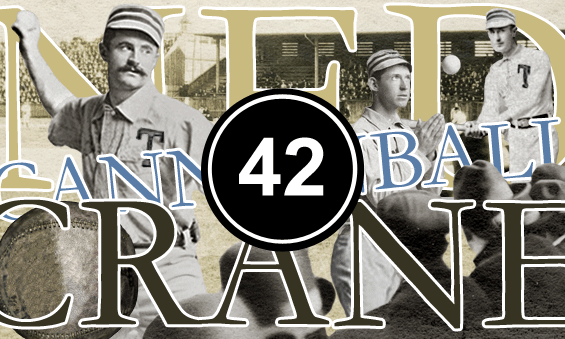
Ned "Cannonball" Crane, 1887

Tuesday, September 15, 2015

Joe Carter's World Series-Winning Dream


The Blue Jays had won the World Series. For the first time in history, Major League Baseball's championship banner was flying north of the border. But winning again wasn't going to be easy. Many of the biggest stars of the 1992 championship team weren't going to be back with the Jays in 1993. Dave Winfield, Jimmy Key, David Cone, Tom Henke: they were all all free agents. None of them would end up returning to Toronto.

Joe Carter was a free agent too. In 1992, he'd been right at the centre of the Blue Jays line-up, hitting third in the order as he belted 34 home runs and racked up 119 RBIs (back in the days when runs batted in was seen as a more telling stat than it is today). He always seemed to be involved in the team's biggest moments. It was Carter's game-winning single that clinched first place in the division that year. And it was Carter who recorded the final out in the World Series: catching the ball at first base and then jumping up and down for joy as the team celebrated their very first championship.

But Carter wasn't sure where he wanted to play in 1993. He loved Toronto, but he lived in Kansas City. Going home to play for the Kansas City Royals was a very tempting proposition. He was torn: he knew he wanted to play for one of those two teams, but he wasn't sure which one to pick.

That winter, Carter met with the owner of the Royals, Ewing Kauffman. Kauffman was an old man now, and his health was failing. He only had a few months left to live. He wanted his baseball team to win — and to do it before he died. So he offered the slugger more money than the Blue Jays were willing to pay, plus an extra year and all the other contractual clauses that Carter was asking for.

Years later, the Kansas City Star asked Carter how close he came to singing with the Royals. The slugger held his finger and his thumb about an inch apart. "Closer than this," he told them.

But that night, after his meeting with Kauffman, Joe Carter had a dream. He told Sportsnet about it as part of an oral history of the 1993 Blue Jays season.

"I was walking to the ballpark with Devon White," he remembered. "It was kind of dark and we came up on the stadium. When I looked up, the lights lit up and it said, 'Welcome to the SkyDome.'"

As Carter woke the following morning, the dream lingered in his mind. And then he looked outside: his backyard was full of birds. They were all blue jays. It was, he thought, a clear sign from God.

That was all he needed. "The next day I signed with the Blue Jays... That's how I came back."

And so in 1993, Joe Carter returned to his familiar role at the heart of the Jays order, helping them get all the way back the World Series. In the bottom of the ninth inning of Game Six, he found himself right in the middle of history, with a chance to live another kind of dream — the kind of dream kids have been dreaming in sandlots and parks and backyards for more than a hundred years. To do something no baseball player had ever done before: to hit a game-winning, come-from-behind home run to win a World Series.

And that's exactly what he did:


-----
 
You can read my Illustrated History of Baseball in Toronto here. Or my post about Toronto's very first championship team — the old-timey Toronto Baseball Club of 1887 — here

I first learned about Joe Carter's dream thanks to Sportsnet's oral history of the 1993 Blue Jays. And you can read the Kansas City Star article about the dream here.

Monday, April 13, 2015

An Illustrated History of Baseball in Toronto

No one knows exactly when baseball was born. There's a bullshit story about an American war hero, Abner Doubleday, inventing the game in the 1830s, but that's a lie. What we do know is that by the end of the 1850s, baseball had already arrived in Toronto. That's when the Globe wrote about a local team practicing every Monday afternoon on the U of T grounds. But back then, many Torontonians still sneered at the new sport — they dismissed it as a sandlot game played by "undesirables." Cricket and lacrosse were much more respectable. And they were much more popular, too.

That didn't last long. Soon, baseball had established itself as one of the most popular games in the city. Local teams were beginning to win followings. In the 1870s, the Toronto Dauntless played a home game at the Toronto Cricket Club (it was at the Grange; the field was nicknamed "The Taddle" after nearby Taddle Creek). Meanwhile, the Toronto Clippers played at Queen's Park. Finally, in the 1880s, our city got our very first professional team. They were originally called the Toronto Baseball Club — they would dominate professional baseball in Toronto for the next eighty years.

Baseball was still so new back then that some of the rules were still being worked out. A pitcher needed four strikes to retire a batter. He could throw five balls before giving up a walk and he was allowed to hit the batter with a pitch. Umpires asked players and fans for their advice. Sacrifice flies didn't exist yet. And it was only now that they started making home plates out of rubber instead of marble.

The Torontos, as they were called, first played at the Jarvis Street Lacrosse Grounds (near Church & Wellesley, where Barbara Hall Park is now). But soon they had their own brand new stadium on a spot overlooking the Don Valley. Spectators could walk in off Queen Street or ride up in their carriages and park their horses on the grounds. Admission was a quarter — or an extra ten cents to sit in the best seats in the house. The sheltered grandstand had enough room for more than 2,000 people. It was originally known as the Toronto Baseball Grounds, but it would soon be nicknamed Sunlight Park in honour of the nearby Sunlight Soap Works factory. When the stadium opened in 1886, even the Lieutenant Governor came to see the first game. Someone in his entourage had their hat knocked off by a foul ball.

Location of Sunlight Park (via "What sports stadiums used to look like in Toronto" on blogTO)
 
The Torontos were one of the founding members of a brand new league. It featured teams from Canada and the north-eastern United States, so they called it the International League. It would eventually grow to become one of baseball's official Minor Leagues. It's still around today. The Blue Jays' AAA team, the Buffalo Bisons, are part of it. 

It didn't take long for the Torontos to make their mark. In their second year in Sunlight Park, they were stacked with star players. Outfielder Mike Slattery stole 112 bases, which is still the International League record. The ace of the pitching staff was a giant of a man: Cannonball Crane. He won 33 games that year — more than any other pitcher has ever won on any Toronto team — and he was also the league's best hitter. (His .428 batting average is still considered to be the best by a pitcher in professional baseball history.) On the final weekend of the season, Crane pitched three times in two days and hit a game-winning home run. It was enough to clinch the pennant. More than a hundred years before Joe Carter hit his famous blast at the SkyDome, Toronto had won our very first baseball championship.

Players from the 1887 Toronto Baseball Club: Mike Slattery, Harry Decker and Cannonball Crane


By the end of the 1800s, the Torontos had a new name: they now called themselves the Toronto Maple Leafs (four decades before the city's hockey team started calling themselves the same thing). Under the new moniker, they quickly grew into one of the most successful teams in all of Minor League Baseball history. Five of their squads are included on the official MLB list of the top 100 greatest Minor League teams ever. And at least a dozen of their players would eventually end up in the Baseball Hall of Fame.

The Leafs were now owned by the Toronto Ferry Company, who were always looking for new ways to lure customers to the islands. (The guy who owned the business, Lol Solman, was the brother-in-law and business partner of the famous rower Ned Hanlan, whose family had been living on the island for years.) The Toronto Ferry Company already owned an old timey amusement park at Hanlan's Point and the beautiful Hotel Hanlan. Now, they added a sports stadium to their empire — it was at Hanlan's Point that the Toronto Maple Leafs played most of their home games for the next thirty years.

You can see the stadium here, built right beside the Circle Swing ride. It also doubled as a venue for lacrosse:

Hanlan's Point Stadium, 1905-1910 (via Wikipedia)

  
And in this photo of a ballgame played at an earlier version of the same stadium in 1897, you can still see evidence of the old Victorian era rules. The umpire stood behind the pitcher — not behind the catcher, like they do today. And there was no mound either — the pitchers threw off flat ground:

Hanlan's Point Stadium, 1897 (via "Baseball's back in town" by Louis Cauz)

  
In another photo from 1907ish, you can see the city's skyline in the background as well as the Circle Swing and some of the other rides

Hanlan's Point Stadium, 1907ish (via the Coaster Enthusiasts of Canada)

While in this photo of the same view in 1908, you can see the Union Jack flying on the right:


But my favourite photo of Hanlan's Point Stadium is probably this one from Opening Day in 1908. (You can click it to enlarge it — and the other photos, too.) On the left, you can see the sails of a few ships just barely poking up above the grandstand. On the right, you can see the championship pennant flapping in the breeze, with a roller coaster called the "Royal George Scenic Railway" to the right of that. Fans were allowed to spill out onto the edges of the field back then; the women in the crowd are standing in the shade of their big Edwardian hats.

Hanlan's Point Stadium, Opening Day 1908 (via "Baseball's back in town" by Louis Cauz)
  
Of course, fans who went to see games at Hanlan's Point were pretty much forced to take the Toronto Ferry Company's ferries. The fleet included the brand new Trillium, which — amazingly — is still in service today. Here it is back around 1913, in the days when the Maple Leafs were still playing on the island:

The Trillium, 1913 (via the Toronto Archives)


But the island wasn't the only place the Leafs played their home games back then. In the very early 1900s, they also spent a few seasons playing at Diamond Park. It was on the mainland, where Liberty Village is now:

Diamond Park, 1900-1907ish (via the Toronto Public Library)
Diamond Park, Opening Day 1907 (via the Toronto Public Library)

  
And it was a good thing the Leafs had a back-up ballpark, because Hanlan's Point Stadium was made of wood. It burned down twice — the second time, in 1909, it took the amusement park and the hotel with it:

Hanlan's Point Fire of 1909 (via "Baseball's back in town" by Louis Cauz)


The Hanlan's Point Fire of 1909 (via the Toronto Archives)

  
This time, Hanlan's Point Stadium was rebuilt in concrete and iron. When it first opened, it was hailed as the biggest ballpark in all of the Minor Leagues. It boasted 18,000 seats, which is almost as many as the Air Canada Centre has today. Over the next few years, it witnessed some of the greatest moments in Toronto baseball history. The Leafs won two more championships and featured future Hall of Famers like second baseman Nap Lajoie (one of the best ever) and the slap-hitting outfielder Wee Willie Keeler (whose famous saying "Hit 'em where they ain't" is still a staple of baseball broadcasts more than a century later).

The new island stadium was also where a young pitcher for the Providence Grays hit his very first professional home run. His name was Babe Ruth. They say his blast soared over the fence and splashed into Lake Ontario.

Hanlan's Point Stadium, 1918ish
  
The amusement park was rebuilt too. The Circle Swing ride wasn't in service any more, but it was at least partially salvaged from the fire. When the new stadium was built, the old ride was re-purposed as a monument, standing guard outside the ballpark, where they lit it up at night. It beats the hell out of a stupid Ted Rogers statue:

Hanlan's Point Stadium, after 1910 (via Chuckman's postcard blog)
  
And just over the right-field fence, you could still find part of a roller coaster:

Hanlan's Point Stadium, 1919 (via the Toronto Archives)


Hanlan's Point Stadium, 1912ish (via the Toronto Archives)
Hanlan's Point Stadium, 1910 (via the Toronto Archives)
Hanlan's Point Stadium, Opening Day 1910ish (via the Toronto Archives)
Hanlan's Point Stadium, 1931 (via the Toronto Archives)


Here, off to the left, you can see the Circle Swing lit up with lights:

Hanlan's Point Stadium, 1928 (via the Toronto Archives)
Hanlan's Point, 1919 (via the Toronto Public Library)

1899 score card (via "Baseball's back in town" by Louis Cauz)
Toronto Maple Leafs, 1897 (via "Baseball's back in town" by Louis Cauz)


Baseball was now big business, but the game still hadn't left the city's sandlots behind. All over Toronto in the early decades of the 1900s, children and adults still played on countless local teams in countless leagues — some professionally, some just for fun, some with their co-workers from offices and factories — and in countless pick-up games in the city's parks, streets, empty lots and backyards. Just like they do today.

They played at Christie Pits (which we still called Willowvale Park back then):

Christie Pits, 1922 (via the Toronto Archives)
Christie Pits, 1920 (via the Toronto Archives)

Christie Pits, 1920 (via the Toronto Archives)


They played at Riverdale Park, on the banks of the Don River, not far from where Sunlight Park once stood:

Riverdale Park, 1930ish (via the Toronto Archives)


Riverdale Park, 1914 (via the Toronto Archives)
Riverdale Park, 1915 (via the Toronto Archives)

   
They played beside the ferry docks at Bayside Park (which we call Harbour Square Park now):

Bayside Park, 1923 (via the Toronto Archives)


And at the Perth Avenue Playground (in what we now call the Junction Triangle): 

Perth Avenue Playground, 1915 (via the Toronto Archives)


Perth Avenue Playground, 1915 (via the Toronto Archives)

  
They played on Deforest Road in Swansea:

Deforest Road, 1900 (via the Toronto Public Library)

 
And in High Park:

High Park, 1922 (via the Toronto Archives)


High Park, 1933 (via the Toronto Archives)
 
And at Sunnyside, too:

Sunnyside, 1924 (via the Toronto Archives)


And it wasn't just men and boys anymore. Back in baseball's earliest days, girls weren't supposed to play. Physical activity was seen as dangerous and inappropriate for women. But times had changed. Now, Toronto's women and girls were picking up bats and balls, forming their own teams and their own leagues, drawing their own big crowds:

1924ish (via the Toronto Archives)
1918 (via the Toronto Archives)
The East Riverdale East Juvenile Baseball Champions, 1923 (via the Toronto Archives)

 
Even Miss Toronto got in on the action. In 1937, the winner of the beauty pageant was a teenaged softball pitcher from the Beaches. The night Billie Hallam won, a police escort raced her from the pageant to a ball game at Kew Gardens and then back to a banquet at the Royal York. ("[T]here is nothing like exercise and sport," she told the press, "to make a girl a real lady.") The next time she returned to the mound, a crowd of ten thousand people was there to see her pitch — the most ever for a game at Kew Gardens. At one point, she even did a photo shoot wearing her uniform:

Billie Hallam, 1937 (via the Toronto Archives)


Billie Hallam, 1937 (via the Toronto Archives)


That very same year, Hanlan's Point Stadium was demolished. But by then, the Toronto Maple Leafs were already long gone. They had a new home.

Maple Leaf Stadium was the city's biggest ballpark yet: with more than 20,000 seats, it was bigger than the biggest Minor League stadiums are today. It was designed in the 1920s by the architects at Chapman & Oxley — the same firm responsible for many other 1920s lake shore icons: the Palais Royale, the Sunnyside Bathing Pavilion and the Princes' Gates. It took a hundred and fifty construction workers and fifty teams of horses to build it. But the entire thing went up in just one off-season, with the crews working right to the very last minute.

This photo was taken just a few weeks before the stadium opened in 1926:

Maple Leaf Stadium, March 6 1926 (via the Toronto Archives)


And this one was taken three days before the first game:

Maple Leaf Stadium, April 26 1926 (via the Toronto Archives)


Maple Leaf Stadium under construction, 1926 (via "Baseball's back in town" by Louis Cauz)

Maple Leaf Stadium ready to open, 1926 (via "Baseball's back in town" by Louis Cauz)


The elegant Maple Leaf Stadium would stand at the foot of Bathurst Street for the next forty years — it was the last home the Leafs would ever know. They won six more championships in that building. And they welcomed even more future Hall of Famers onto their rosters: players like the slugger Ralph Kiner and the pitcher Carl Hubbell (who once famously struck out five future Hall of Famers in a row at an All-Star Game, starting with Babe Ruth and Lou Gehrig). One of Toronto's second basemen, Sparky Anderson, became the manager of the team in the 1960s — it was the first gig in a managing career that would land him in the Hall of Fame, too. Meanwhile, some of the biggest giants in baseball history came by for a visit: Branch Rickey threw out the first pitch when the stadium first opened; Major League Commissioner Kenesaw Mountain Landis had stopped by, too. Ty Cobb got the very last hit of his career in an exhibition game against Toronto at Maple Leaf Stadium in 1928.

Opening Day, in particular, was a party. Players had paraded through the streets of Toronto before their first home game of every season since all the way back in the 1800s. And the tradition continued at Maple Leaf Stadium. In 1960, for instance, the players met fans at the King Edward Hotel the night before. Then, on the afternoon of the game, they paraded up Bay Street from the lake to Old City Hall. They rode in convertibles, joined by four bands, baton twirlers and colour guards. Mayor Nathan Phillips was there waiting to meet them. He declared it to be "Baseball Day" in Toronto. Then everyone headed over to the stadium.

Jim Hunt wrote about it for the Toronto Daily Star: "Opening day is the most wonderful of the year. Fans who may not go to another game will be there. School kids who have buried a grandmother for the past five seasons will have another funeral tomorrow. And spring will have arrived. Officially, it came on March 21 but for a baseball fan it isn't spring until the ump bawls: 'Play ball' at Maple Leaf Stadium."

Maple Leaf Stadium, 1929 (via the Toronto Archives)


Maple Leaf Stadium (via the Toronto Archives)

Maple Leaf Stadium, Coronation Day 1937 (via the Toronto Archives)


Maple Leaf Stadium, Opening Day 1961 (via the Toronto Archives)


Maple Leaf Stadium, Opening Day 1961 (via the Toronto Archives)
Maple Leaf Stadium, 195something (via the Toronto Archives)


Maple Leaf Stadium (via "Baseball's back in town" by Louis Cauz)


Maple Leaf Stadium, 1940s or '50s (via the Toronto Archives)


Maple Leaf Stadium (via the Toronto Archives)

Maple Leaf Stadium (via the Toronto Archives)


The 1926 Toronto Maple Leafs (via Mop Up Duty)


Program, 1946 (via Mop Up Duty)
  
Here, you can see some familiar Toronto institutions advertising on the outfield wall. There are three  in a row, left to right: the Horseshoe Tavern, Loblaws, and Tip Top Tailors. You can also see that the fans were still allowed to spill into the outfield. Some are sitting where the warning track would be today; others are perched atop the wall itself:

Maple Leaf Stadium (via the Toronto Archives)

  
When the Maple Leafs' reached their Diamond Jubilee, they got a new mascot: a cartoon of an old timey baseball player called Handlebar Hank. You could find him on the sleeves of their uniforms for a while, and towering over the main entrance to the stadium:

Handlebar Hank (via "Baseball's back in town" by Louis Cauz)


Outside the stadium, you would find the familiar chaos of traffic jams, parking frenzies and crowds:

Maple Leaf Stadium, 1932ish (via the Toronto Archives)

Crowds outside the stadium, post-war (via "Baseball's back in town" by Louis Cauz)

Maple Leaf Stadium, 1956 (via the Vintage Chevrolet Club of America)

Maple Leaf Stadium (via Digital Ballparks)

  
While the stadium might be gone today, many of the neighbourhood's landmarks are still there. Next door, the Tip Top Tailors building has been turned into condos. Across Fleet Street, the old Loblaws warehouse is now being turned into a new store and some more condos. And the silos of the old Canada Malting complex (behind the outfield wall, next to the lake) are still there today, too:

Maple Leaf Stadium (via High On History)

During the Maple Leaf Stadium years, the International League expanded to become even more international. In the 1950s, the Leafs made regular trips all the way down to Cuba to take on the Havana Sugar Kings. (They were part of the league until the early 1960s, when the JFK administration brought in the embargo against Castro's regime.) For a while, there was a team in San Juan, Puerto Rico, too.

But the International League's greatest moment came in the 1940s. All the way back in 1887 — the year Toronto won their first championship — they'd made history by becoming the first baseball league to officially ban Black players. Now, they were on the right side of history. In 1946, the Montreal Royals signed a new player by the name of Jackie Robinson. He played his first professional games for them in the International League, including some at Maple Leaf Stadium. He led the league in hitting that year and led the Royals to the championship. The next year, he became the very first player to break Major League Baseball's colour barrier.

Jackie Robinson, 1946 (via Cooperstown in Canada)


In the 1950s, the Maple Leafs got a new owner, too. This guy in the tie, Jack Kent Cooke:

Jack Kent Cooke (left, via the Toronto Archives)


Cooke grew up in the Beaches, went to Malvern Collegiate and started his career by selling encyclopedias. But before long, he had landed a media job under Roy Thomson; by the time he turned 30, he'd already made his first million. Eventually, he would go on to own the L.A. Lakers, the L.A. Kings, the L.A. Daily News, and the racistly-named football team in Washington. He even bought the Chrysler Building in New York City. He owned it until the day he died.

When he took over the Leafs, they were struggling. Attendance was down; the teams were terrible. But Cooke turned it all around, investing in star players and doing everything he could to make Maple Leaf Stadium the place to be, no matter how crazy his ideas might seem. There were raffles. Giveaways. Free hot dog promotions. Celebrity guests. Ladies' nights. Family nights. Cheerleaders. Flagpole sitters. Fireworks. One night, they gave away a pony. Another day, there was a diaper-changing contest held at home plate. Players were drafted into a cow-milking competition. If you brought a black cat to the stadium on Friday the 13th, you got free tickets. And it all worked like a charm. Attendance doubled, setting a new Minor League record. Cooke was named Minor League Executive of the Year. The team even started winning pennants again.

But Cooke's big dream was to bring a Major League Baseball team to Toronto. People had been talking about it ever since the 1800s. Even Al Spalding, the founder of the National League, had suggested it. And Cooke was determined to finally make it happen. Every time a Major League team was struggling, or thinking about moving to a new city, there he was with his cheque book in his hand. He tried to buy the Braves. The Orioles. The A's. The Tigers. When that didn't work, he tried to land an expansion franchise. But he was foiled at every turn.

Eventually, he gave up. He moved to Los Angeles and sold the Leafs. It was the death knell for the franchise. They would only last another three years. After eight decades as the biggest baseball team in Toronto, the Maple Leafs were finished. They moved to Louisville in 1967. Maple Leaf Stadium was demolished in 1968. Today, there are condos and a gas station where it once stood.

But Cooke wasn't the only one who dreamed of bringing Major League Baseball to Toronto.

In the 1970s, there was a new ownership group who followed in his footsteps. Labatt teamed up with CIBC and the head of the Globe and Mail. They were planning to buy the San Francisco Giants and move them to Toronto. In 1976, the deal was done. They'd even renovated Exhibition Stadium to accommodate the new team. But then the mayor of San Francisco stepped in. There was a court case. San Francisco won. The Giants stayed where they were.

But the dream still wasn't dead. There was one more chance. The Major Leagues were expanding; they were going to add two more teams the following year. One would end up in Seattle. The other, it seemed, would come down to Washington or Toronto — with President Gerald Ford lobbying hard on behalf of the American capital.

He lost.

On April 7, 1977, it was snowing in Toronto. But no one cared. More than 40,000 people made the trek down to crappy old Exhibition Stadium on the CNE Grounds. They packed the bleachers overlooking the artificial turf, huddling against the cold while a Zamboni borrowed from Maple Leaf Gardens cleared the snow off the field. Mayor David Crombie was there that day. So was Foster Hewitt. All over the country, people tuned into the CBC to watch Anne Murray sing "O Canada". And then, for the very first time, the Toronto Blue Jays took the field.

Ten years after the death of the Maple Leafs, baseball was back in Toronto. And the rest, as they say, is history:

Exhibition Stadium, Opening Day 1977 (via the Globe and Mail)


The Toronto Star celebrates Opening Day 1977 (via Berger Bites)

George Bell and the Blue Jays clinch their first pennant, 1985 (via the Blue Jay Hunter)

SkyDome under construction (via The Grid)
SkyDome under construction (via Stadiumpage.com)


Skydome Opening Day, 1989 (via Blue Jays Fans)

Joe Carter and the Blue Jays win their first World Series, 1992 (via Sportsnet)

Joe Carter's home run wins the 1993 World Series at the SkyDome


-----

I've also written about Nap Lajoie, Toronto's greatest second baseman ever, and the 1887 Toronto Baseball Club, who brought home our city's very first baseball championship

The most extensive history of baseball in Toronto was written by Louis Cauz in "Baseball's back in town", which you can borrow from the Toronto Public Library here, or buy from Amazon here.

The Torontoist guys have a whole whack of Historicist articles about the history of baseball in Toronto. Kevin Plummer writes about Jack Kent Cooke here, about Lol Solman here, about Billie Hallam here, about old timey Maple Leaf tobacco cards here, about the Toronto-born Arthur Irwin, baseball player and polygamist here, and about the amateur Toronto Oslers turning pro here. Meanwhile, Jamie Bradburn writes about Toronto's long road to a domed stadium here and he has a brand new post about the first Opening Day at Maple Leaf Stadium here.

Over on blogTO, Chris Bateman has a brand new post about those 1887 champions here. And Derek Flack's has an old post about "What sports stadiums used to look like in Toronto" here.

The Washington Post has more about Jack Kent Cooke here. And the American National Biography Online has more here.

You can learn more about the history of the International League here. And more about the Hanlan's Point Amusement Park from Coaster Enthusiasts of Canada here.

The New York Times wrote about Toronto and baseball just before the 1992 World Series here. The Atlanta Constitution newspaper got all ethnocentric about it, running the big headline, "This is OUR game!" More than 20 years after the Jays beat them for the championship, they still have a team so racist that their big cheer is the unbelievably offensive "tomahawk chop".

There's more about about the Toronto Cricket Club thanks to Edgar A. Bracht in this PDF.

And over on Mop Up Duty, Daperman shares his own personal memories of Maple Leaf Stadium here.